The Department of Transportation (DOT) plays a critical role in maintaining safety and efficiency across the nation’s transportation systems, especially in the trucking industry, where safety, compliance, and accountability are non-negotiable. Through agencies like the Federal Motor Carrier Safety Administration (FMCSA), the DOT establishes and enforces a wide range of rules and regulations designed specifically to govern commercial vehicle operations on U.S. roads.
For commercial truck drivers, these DOT rules and regulations are more than just red tape, they’re the foundation of professional driving. Whether you’re an owner-operator hauling loads cross-country or a fleet driver working regional routes, knowing and following DOT guidelines is essential to staying legal, safe, and on the road. From hours of service rules to vehicle inspections, drug and alcohol testing, and proper documentation, there are many compliance standards that drivers must follow daily.
Failing to comply with DOT regulations doesn’t just lead to fines, it can result in roadside shutdowns, suspended licenses, and even jeopardize your career. That’s why it’s crucial for every commercial driver to understand the most important DOT requirements and how they apply to your everyday operations.
What Are DOT Rules and Regulations?
DOT rules and regulations refer to the set of federal safety, operational, and compliance standards established by the U.S. Department of Transportation (DOT) to oversee commercial motor vehicles (CMVs) and the people who operate them. These regulations are designed to promote road safety, reduce accidents, protect drivers and the public, and ensure that transportation systems run efficiently across state and national lines.
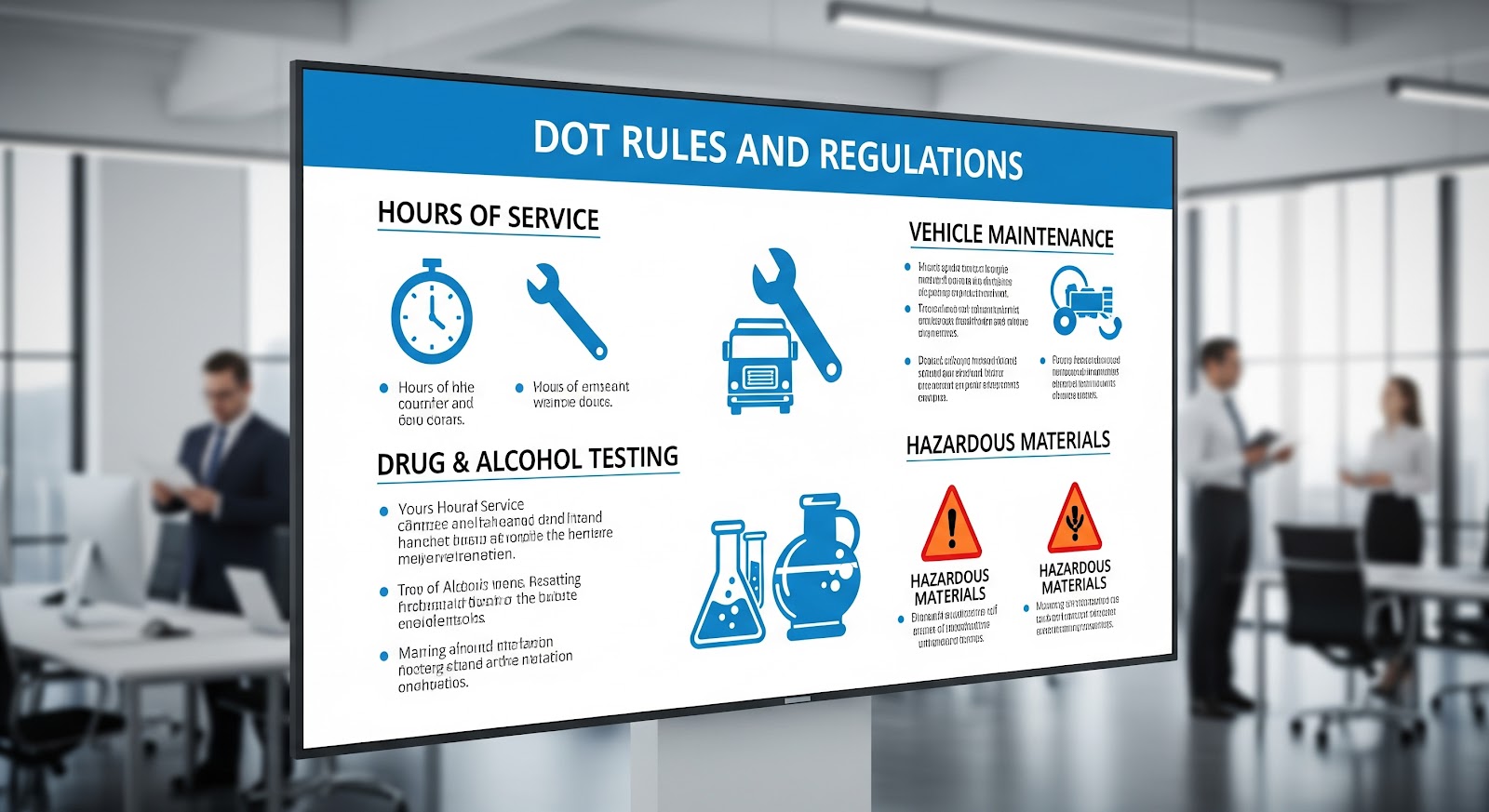
At the heart of these efforts is the Federal Motor Carrier Safety Administration (FMCSA), a division of the DOT that specifically governs the commercial trucking and bus industries. The FMCSA is responsible for writing, updating, and enforcing rules that cover a broad range of trucking-related topics, such as:
- Driver qualifications
- Hours of service limits
- Drug and alcohol testing
- Vehicle maintenance and inspection standards
- Cargo securement
- Recordkeeping and documentation
- Safety ratings and compliance reviews
These regulations aren’t optional, they are legally binding and must be followed by nearly everyone involved in commercial trucking operations. Here’s who is typically required to comply:
Who Must Follow DOT Regulations?
- CDL (Commercial Driver’s License) Holders – Any individual operating a vehicle over 26,000 pounds, transporting hazardous materials, or carrying more than 16 passengers must comply.
- Interstate Carriers – Companies or drivers transporting goods or passengers across state lines must follow all FMCSA and DOT rules.
- Intrastate Carriers – Even drivers who operate within a single state may be subject to DOT rules, depending on their vehicle’s size, cargo type, or state-specific laws.
- Owner-Operators – Independent drivers running under their own authority must ensure full DOT compliance, including maintaining a DOT number, medical certification, and proper documentation.
- Fleet Operators and Motor Carriers – Trucking companies are responsible for ensuring all their drivers, vehicles, and operations meet DOT standards.
- Leasing Companies and Logistics Providers – Any business that owns or manages commercial vehicles must also comply with applicable DOT regulations.
DOT rules are constantly evolving to adapt to new technology, road safety data, and industry trends. That’s why it’s essential for drivers and carriers to stay updated on changes, maintain proper documentation, and prioritize compliance in daily operations.
Key DOT Regulations Every Truck Driver Should Know
To stay compliant, avoid costly penalties, and keep your career on track, it’s critical for every commercial truck driver to understand and follow these core DOT regulations. These guidelines are enforced by the Federal Motor Carrier Safety Administration (FMCSA) and apply to nearly all commercial motor vehicles operating in the U.S.
1. Hours of Service Rules
The Hours of Service (HOS) regulations are among the most critical rules enforced by the Federal Motor Carrier Safety Administration (FMCSA). These regulations are designed to prevent driver fatigue, a leading cause of accidents involving commercial vehicles by limiting how long drivers can be behind the wheel without adequate rest.
At their core, HOS rules are about balancing productivity with safety. They establish clear guidelines for driving time, on-duty hours, required breaks, and rest periods, ensuring drivers have enough time to recover before returning to the road.
Let’s break down the key HOS regulations every driver must follow:
11-Hour Driving Limit
After taking 10 consecutive hours off-duty, a driver is allowed to drive for up to 11 hours within a 14-hour on-duty window. This means that even though a driver may be on the clock for 14 hours, only 11 of those can be spent driving. The remaining time can be used for fueling, loading, inspections, or other non-driving tasks.
14-Hour Workday Rule
The 14-hour rule sets a firm limit on the total time a driver can be on duty after starting a shift. Once the clock starts, it does not pause, even for breaks or non-driving tasks. After 14 hours, a driver must go off-duty, regardless of how much actual driving was done during that period. This rule is crucial for ensuring drivers don’t remain active and alert for excessive hours, which can lead to diminished focus and slower reaction times.
30-Minute Break Requirement
To help manage fatigue during long drives, drivers must take a 30-minute off-duty break after 8 cumulative hours of driving time. This break can be taken in any form of off-duty status, including sleeper berth time, and gives drivers a chance to rest, eat, or refresh before continuing their route.
60/70-Hour Duty Limit
In addition to daily limits, HOS rules also set weekly caps. A driver may not exceed 60 hours on duty over 7 consecutive days (if the carrier operates 7 days a week) or 70 hours over 8 consecutive days (if the carrier operates 8 days a week). Once these limits are reached, drivers must go off-duty until they have enough rest time to bring their weekly total back below the threshold.
34-Hour Restart Rule
To reset the 60/70-hour clock, drivers can take at least 34 consecutive hours off-duty. This is known as the 34-hour restart and is typically used at the end of a workweek or during extended layovers. This rule ensures that drivers get enough rest before starting a new duty cycle, enhancing long-term safety.
Electronic Logging Device (ELD) Mandate
To enforce HOS compliance, the FMCSA requires the use of Electronic Logging Devices (ELDs) for most commercial drivers. These devices automatically record driving time, engine hours, vehicle movement, and other critical data. By replacing outdated paper logs, ELDs reduce the risk of logbook falsification and make it easier for both drivers and carriers to track hours accurately.
ELDs have become a cornerstone of modern fleet safety and compliance. Not only do they help carriers avoid penalties during roadside inspections and audits, but they also create a transparent record of driver activity, protecting both drivers and employers from liability.
2. DOT Drug and Alcohol Testing
The DOT drug and alcohol testing program is a cornerstone of commercial motor vehicle safety. Because truck drivers perform safety‑sensitive functions, the Department of Transportation enforces strict rules to ensure that drivers are not impaired while operating heavy vehicles. These regulations are designed to protect not only drivers, but also the motoring public and the companies responsible for commercial transportation.
Under DOT regulations, drug and alcohol testing is not optional. Any CDL driver operating a commercial motor vehicle subject to DOT oversight must participate in a federally mandated testing program administered by their employer or motor carrier. Failure to comply with testing requirements can result in immediate removal from service, fines, loss of CDL privileges, and long-term career consequences.
Types of Required DOT Drug and Alcohol Testing
DOT regulations require testing at specific times throughout a driver’s employment to ensure ongoing compliance and safety:
- Pre‑Employment Testing: Before a driver can operate a CMV, they must pass a DOT‑regulated drug test. A driver cannot be dispatched or placed behind the wheel until a negative test result is received.
- Random Testing: Random tests are conducted throughout the year without advance notice. Drivers are selected through a neutral, computer‑generated process, and must report for testing immediately when notified. Random testing acts as a strong deterrent against drug and alcohol use while on duty.
- Post‑Accident Testing: Certain accidents require post‑accident testing, particularly when there is a fatality, a citation, or a vehicle is towed or someone is injured. These tests help determine whether substance use may have contributed to the incident.
- Reasonable Suspicion Testing: If a trained supervisor observes behavior that suggests impairment, such as slurred speech, unsteady movement, or erratic behavior, the driver may be required to undergo immediate testing. Proper documentation by the supervisor is required.
- Return‑to‑Duty and Follow‑Up Testing: Drivers who violate DOT drug or alcohol regulations must complete the return‑to‑duty process, which includes evaluation by a Substance Abuse Professional (SAP), a negative test result, and a series of follow‑up tests over a defined period. These follow‑up tests are unannounced and closely monitored.
Who Is Tested and How Often?
All CDL drivers operating DOT‑regulated commercial vehicles are subject to drug and alcohol testing. Motor carriers are responsible for maintaining a compliant testing program and ensuring all eligible drivers are enrolled.
The FMCSA sets minimum annual testing rates, which carriers must meet:
- Drug Testing: At least 50% of drivers must be randomly tested each year
- Alcohol Testing: At least 10% of drivers must be randomly tested each year
These percentages are reviewed annually and can change based on industry data and violation rates. Carriers that fail to meet testing requirements risk audits, fines, and enforcement actions.
3. CDL Medical Requirements
To ensure safety on the road, the Department of Transportation (DOT) requires all commercial drivers to meet specific medical qualifications. Operating a heavy vehicle demands physical stamina, mental clarity, and fast reaction times, so passing a DOT medical exam is essential for maintaining a Commercial Driver’s License (CDL).
The DOT physical exam is not just a formality, it’s a federally mandated health screening designed to confirm that a driver is physically and mentally capable of handling the challenges of long-haul driving, extended hours, and emergency situations on the road.
What Does the DOT Medical Exam Include?
The exam, performed by a certified medical examiner listed on the National Registry (required by FMCSA), is documented using Form MCSA-5875 and evaluates several key health areas:
- Vision and Hearing – Drivers must meet minimum standards for visual acuity (at least 20/40 vision in each eye, with or without correction) and be able to hear a forced whisper from at least 5 feet away.
- Blood Pressure and Cardiovascular Health – High blood pressure must be controlled. The examiner checks for signs of heart disease or other cardiovascular risks.
- Neurological Function – Any history of seizures, brain injuries, or disorders like epilepsy is closely evaluated.
- Musculoskeletal Fitness – The exam also ensures that drivers have the physical ability to operate a truck, including climbing in and out, securing loads, and maintaining control during emergency maneuvers.
- Urinalysis – While not a drug test, the urinalysis checks for underlying medical issues such as diabetes or kidney problems.
Medical Certificate Validity
If a driver passes the exam, the medical examiner will issue a Medical Examiner’s Certificate (DOT Medical Card). This certificate is typically valid for up to 24 months. However, if the examiner identifies a medical condition that needs monitoring, such as high blood pressure or early-stage diabetes, the certificate may be issued for a shorter duration, like 3, 6, or 12 months.
It’s the driver’s responsibility to keep their certificate current and provide a copy to their state’s CDL office. Driving with an expired medical certificate can result in CDL disqualification and fines.
Disqualifying Conditions and FMCSA Exemptions
Certain medical conditions may disqualify a driver from obtaining or renewing their medical certificate, including:
- Uncontrolled diabetes (especially insulin-dependent without FMCSA exemption)
- Epilepsy or a history of seizures
- Certain heart conditions
- Use of prohibited medications, such as narcotics or sedatives that impair alertness
However, the FMCSA does allow for medical exemptions or waivers in specific cases. Drivers with conditions that are well-managed may apply for an exemption, often requiring supporting documentation and additional medical evaluations.

4. Vehicle Maintenance and Inspections
Maintaining commercial vehicles in safe, roadworthy condition is not just best practice, it’s a federal requirement under DOT regulations. Poor vehicle maintenance is a leading cause of roadside breakdowns, accidents, and violations that can sideline your operations and cost you money.
Both drivers and motor carriers have shared responsibility for ensuring every vehicle is thoroughly inspected, regularly serviced, and properly documented. Failing to meet these standards can result in out-of-service orders, fines, and serious safety risks.
Pre-Trip and Post-Trip Inspections
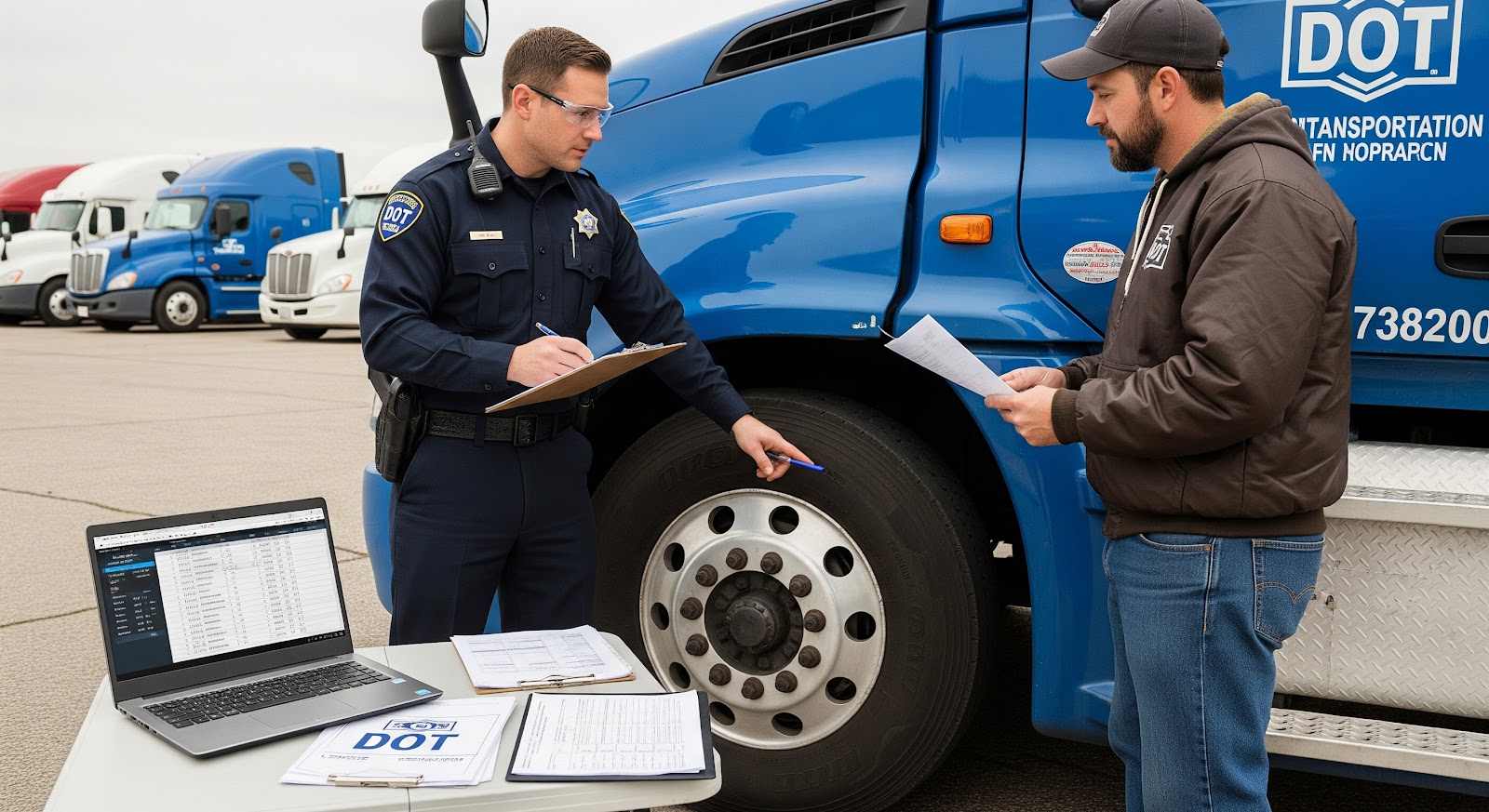
Every driver is required by the DOT to perform both pre-trip and post-trip inspections to identify any mechanical issues before and after operating a commercial motor vehicle.
- Pre-trip inspections must be completed before a driver begins their shift. These inspections include checks on brakes, tires, steering components, lights, reflectors, mirrors, horn, windshield wipers, emergency equipment, and more. The goal is to identify any defect that could affect the safe operation of the vehicle.
- Post-trip inspections are done at the end of the driving day, with any defects or maintenance concerns documented in a Driver Vehicle Inspection Report (DVIR).
Not only are these inspections a legal requirement, they are critical to preventing breakdowns or accidents while on the road. Drivers must report any safety defects that could affect vehicle performance, and carriers are responsible for correcting them before the vehicle is dispatched again.
Maintenance Logs and Recordkeeping
Motor carriers are required to maintain detailed maintenance records for every vehicle they operate. These records must include:
- Inspection reports
- Repair logs
- Maintenance history
- Parts replacements and service dates
These records must be retained for at least 30 days (often longer depending on state and federal guidelines) and must be made available during audits, DOT inspections, or compliance reviews.
Having an organized and up-to-date maintenance file not only helps demonstrate compliance, it also protects carriers from liability in the event of an accident or equipment failure.
Out-of-Service Criteria
If a commercial vehicle is found to have serious mechanical defects, it can be immediately placed out of service by DOT or enforcement officials. This means the truck cannot be operated until the issues are resolved and documented as repaired.
Common out-of-service violations include:
- Brake system failures or leaks
- Steering defects
- Inoperable lights or signals
- Worn tires or tire separation
- Missing or damaged safety equipment
An out-of-service order is more than an inconvenience, it can delay deliveries, damage a company’s safety rating, and even trigger additional inspections or audits.
5. Driver Qualification File (DQF)
In the eyes of the DOT and FMCSA, driver safety begins with documentation. That’s why every motor carrier, whether you’re a large fleet operator or a single-truck owner-operator, must maintain a Driver Qualification File (DQF) for each CDL driver they employ or lease.
The DQF is more than just a personnel file. It’s a federally mandated record that proves each driver is legally qualified, medically fit, and properly licensed to operate a commercial motor vehicle (CMV). It plays a crucial role during DOT audits, roadside inspections, and compliance reviews.
Failing to maintain a complete and current DQF can result in serious penalties and may jeopardize your company’s DOT safety rating.
What Must Be Included in the DQF?
Each Driver Qualification File must include specific documents that demonstrate the driver’s qualifications and safety history. These required items include:
- Copy of a Valid CDL: The driver must have a current Commercial Driver’s License appropriate for the vehicle type they operate.
- DOT Medical Examiner’s Certificate: Proof that the driver has passed a DOT physical exam and is medically certified to drive.
- Motor Vehicle Record (MVR) – Last 3 Years: Carriers must obtain the driver’s MVR from each state where the driver held a license in the past three years. This verifies driving history, license status, and any violations.
- Previous Employer Safety Performance History: A record of the driver’s performance, violations, or accidents from prior employers over the last three years. This is required for evaluating a driver’s safety track record.
- Annual Certificate of Violations and Annual Review: Each year, drivers must report any traffic convictions, and the carrier must review and sign off on their driving record.
- Road Test Certificate or CDL Equivalent: Carriers must certify that each driver has passed a road test, or that their CDL serves as an equivalent proof of road competency.
DQF Compliance Tips
- The DQF must be kept up to date at all times. When a driver renews a license or medical card, those updates must be reflected in the file.
- Files must be easily accessible in the event of a DOT audit, and carriers must be able to produce them upon request.
- Even terminated drivers’ DQFs must be retained for at least three years after employment ends.
6. DOT Number and Operating Authority
Before any commercial truck hits the road legally in the U.S., the company or individual operating it must have the proper federal registration and operating authority. This means securing a DOT Number, and in many cases, an MC Number, two critical identifiers that establish your legal right to operate in interstate commerce.
Understanding the difference between these two numbers and knowing whether you need one or both, is essential for maintaining DOT compliance and avoiding costly violations.
What Is a DOT Number and Who Needs One?
A DOT Number is issued by the Federal Motor Carrier Safety Administration (FMCSA) and acts as a unique identifier for a trucking company or owner-operator. It’s used by federal and state agencies to track safety records, compliance history, crash investigations, inspections, and more.
You are required to obtain a DOT Number if:
- You operate commercial vehicles weighing over 10,000 lbs (GVWR or GCWR) in interstate commerce
- You transport hazardous materials that require placards
- You operate as an intrastate carrier in a state that requires DOT Numbers for in-state operations (e.g., Texas, California, Pennsylvania)
In short: If you’re using a truck for business and crossing state lines or hauling certain types of cargo, you probably need a DOT Number.
Once issued, your DOT Number must be clearly displayed on both sides of your commercial vehicle, along with your business name. It should be visible, legible, and in contrasting colors.
When Is an MC Number Required?
In addition to a DOT Number, many carriers also need an MC Number (Motor Carrier Number), which grants operating authority to transport regulated goods or passengers-for-hire across state lines.
You are required to have an MC Number if you:
- Engage in for-hire transportation (you’re paid to move goods or passengers)
- Cross state lines while transporting regulated commodities or passengers
- Operate as a broker or freight forwarder arranging transportation on behalf of others
Your MC Number is what legally allows you to conduct business in interstate commerce as a for-hire carrier. Without it, you may face severe penalties, including being ordered off the road.
How to Apply and Stay Compliant
Registering for both a DOT and MC Number is done through the FMCSA’s Unified Registration System (URS). The application process requires key business information, including:
- Legal business name and structure
- Principal place of business
- Employer Identification Number (EIN)
- Details about your operation (e.g., cargo types, number of vehicles)
- Proof of insurance coverage and BOC-3 process agent filing (for MC authority)
Once registered, here’s how to stay compliant:
- Display your DOT Number (and MC Number, if required) on your vehicle
- Maintain current insurance levels based on the type of cargo you haul
- Keep business information up to date in the FMCSA system
- Participate in the biennial MCS-150 update, even if your information hasn’t changed
7. Weight Limits and Load Securement
When it comes to trucking safety and compliance, what you haul and how much it weighs, matters just as much as how you drive. The Department of Transportation (DOT) and the Federal Motor Carrier Safety Administration (FMCSA) enforce strict weight limits and cargo securement rules to protect roadways, ensure vehicle stability, and prevent dangerous load shifts or accidents.
Whether you’re hauling freight across state lines or operating within one region, staying within legal weight limits and properly securing your cargo is essential for both road safety and regulatory compliance.
Weight Limit Regulations
The FMCSA has established maximum weight limits for commercial motor vehicles, and exceeding them can result in steep fines, out-of-service orders, and even damage to your vehicle. These limits are especially important at weigh stations and roadside inspections, where enforcement is frequent and strict.
Here are the standard federal weight limits:
- Single Axle: 20,000 lbs
- Tandem Axle: 34,000 lbs
- Gross Vehicle Weight (GVWR): 80,000 lbs total (for most vehicles without a special permit)
In some cases, special overweight permits may be issued for loads that exceed these limits, such as oversized equipment or certain types of construction materials. However, operating without a valid permit when required can lead to serious legal and financial consequences.
Drivers must always be aware of both their vehicle’s gross weight and the distribution of weight across axles, as improper balancing can affect braking, steering, and overall control.
Cargo Securement Requirements
It’s not enough to just load a trailer, you must also secure the cargo properly to prevent movement, tipping, or ejection during transport. The FMCSA has strict standards for cargo securement, especially for vehicles operating in interstate commerce.
Key cargo securement rules include:
- Use appropriate tie-downs, straps, chains, and anchor points rated for the load you’re hauling.
- Cargo must be secured against movement in all directions (forward, backward, sideways, and vertically).
- Use blocking or bracing as needed to keep the load in place, especially with loose or irregularly shaped items.
- Inspect securement devices regularly throughout the trip, especially after the first 50 miles and every 150 miles thereafter.
Certain cargo types have specific securement guidelines, including:
- Logs and lumber
- Metal coils
- Heavy machinery and equipment
- Vehicles and shipping containers
- Pipes or concrete products
Failing to follow securement regulations doesn’t just pose a danger, it can result in severe fines, points on your CSA (Compliance, Safety, Accountability) score, and even cause accidents that lead to injury or loss of cargo.
How ExpressTruckTax Helps with DOT Compliance
While the DOT and FMCSA enforce a wide range of regulations, one of the most commonly overlooked, but critical, areas of compliance for truckers is proper tax filing, documentation, and vehicle identification. That’s where ExpressTruckTax plays a crucial role in helping drivers, owner-operators, and fleet managers stay compliant and on the road legally.
Here’s how ExpressTruckTax supports your DOT compliance efforts:
VIN Checker and Free VIN Corrections
Incorrect or invalid Vehicle Identification Numbers (VINs) are one of the top reasons filings are rejected by the IRS, and can even lead to issues during DOT inspections or DMV registration.
- VIN Checker Tool: Instantly detect common errors like transposed numbers, invalid characters, or mistyped internal codes that may be mistakenly used as VINs.
- Free VIN Corrections: If you filed your Form 2290 through ExpressTruckTax and need to fix a VIN, we offer free corrections, with no hidden fees or delays.
- This helps prevent problems during roadside inspections, DOT audits, or while renewing your tags at the DMV.
IRS Schedule 1 Filing to Stay Road Legal
One of the key requirements to legally operate a heavy vehicle is a stamped IRS Schedule 1, which serves as proof that your Heavy Vehicle Use Tax (HVUT) has been paid.
- With ExpressTruckTax, you can e-file Form 2290 and receive your IRS-stamped Schedule 1 within minutes, helping you avoid costly delays at registration offices.
- Many DMVs require Schedule 1 to renew your registration, so filing through us ensures you always have the documentation DOT inspectors and state agencies need.
Stay Compliant with HVUT Filing Requirements
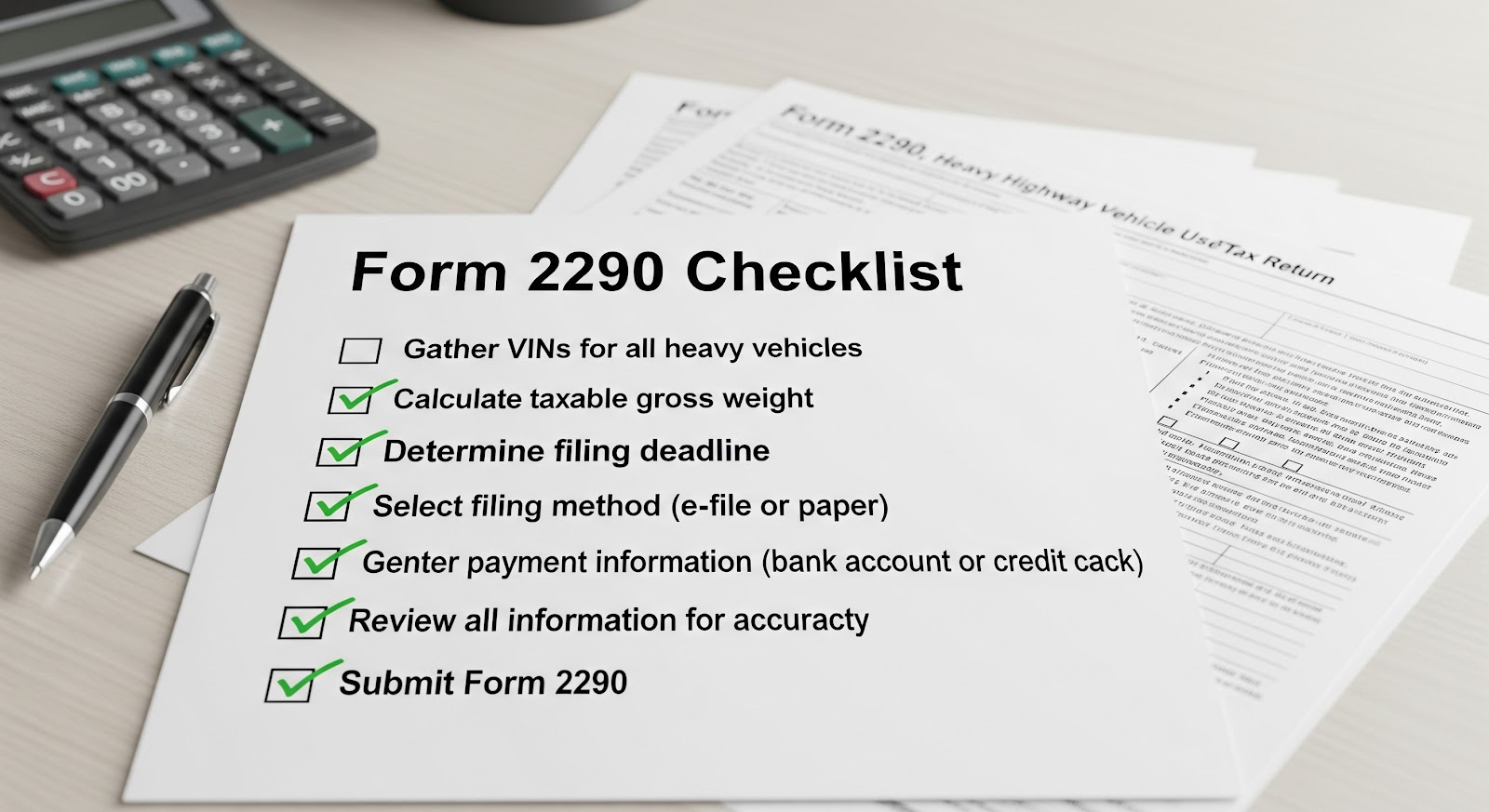
All heavy vehicles with a taxable gross weight of 55,000 pounds or more must file Form 2290 annually with the IRS. Missing the HVUT filing deadline or underreporting can lead to penalties, interest, or compliance issues.
- ExpressTruckTax makes HVUT filing simple and fast with an easy 3-step process:
- Enter business and vehicle info
- Choose payment method
- E-file and receive your stamped Schedule 1
- Enter business and vehicle info
- We also support pro-rated filings for newly acquired vehicles and amendments for weight increases or mileage limit exceedances, both of which are important DOT-related changes that require proper documentation.
By filing with ExpressTruckTax, you’re doing more than just submitting a form, you’re staying compliant, avoiding penalties, and making sure your paperwork is always in order when it counts most. Whether you’re a one-truck owner-operator or managing a nationwide fleet, our platform helps you stay on top of your DOT requirements with confidence.