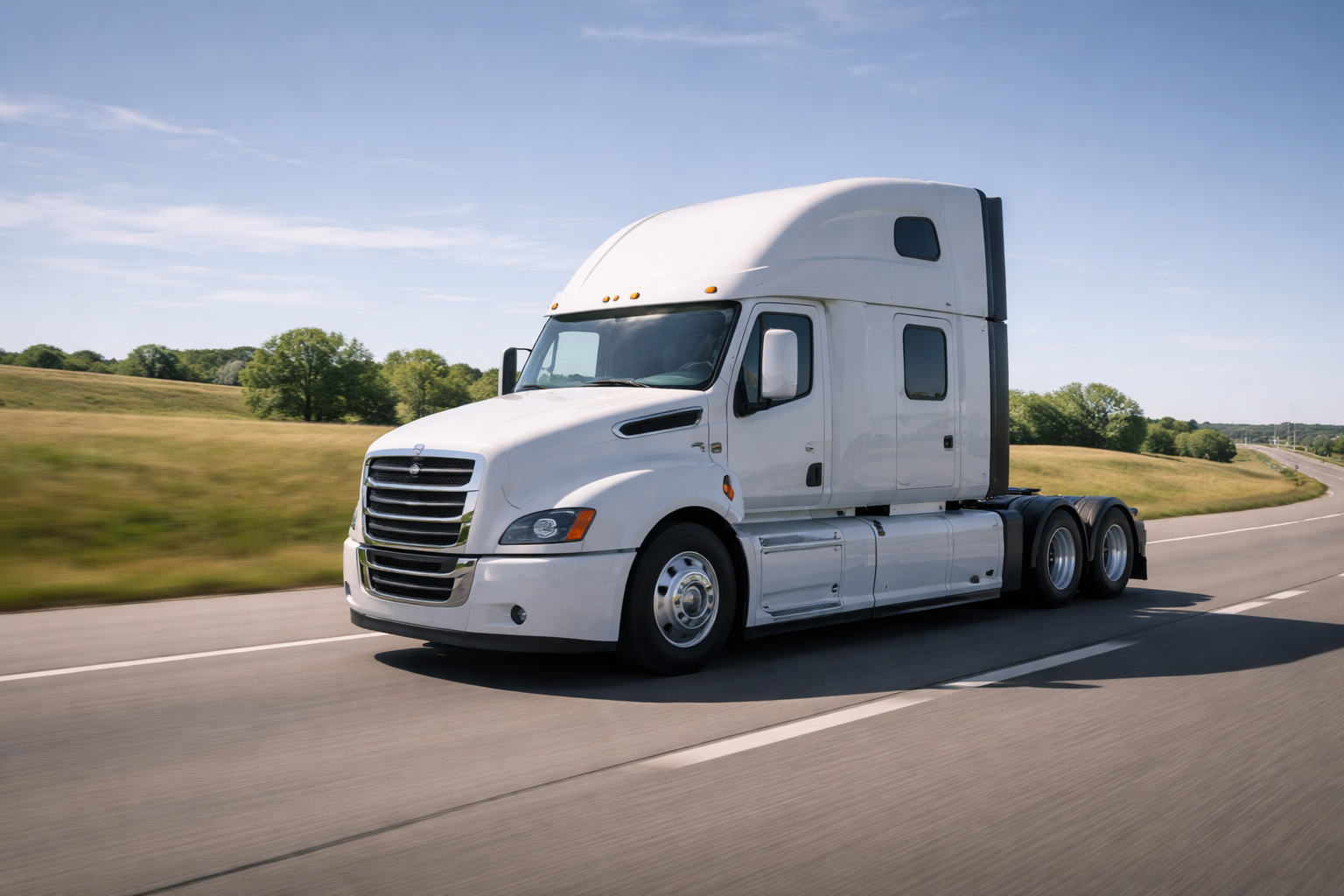
Most buyers start with the sticker on the window, but the number that matters is the total you’ll actually pay and what it will cost to run the truck over time. In other words, a semi’s “price” has layers: the quoted build price, the out-the-door total, and the long-run operating cost. Understanding those layers turns the broad question “how much is a semi truck” into a specific, workable budget.
Think of the purchase in two steps. First is the out-the-door amount: the negotiated truck price plus mandated charges and local costs. Second is total cost of ownership, which captures everything the truck will cost over the years you run it. Together, they define the real price of your truck.
Semi Truck Cost: Sticker, Out-the-Door, and Total Cost of Ownership
The out-the-door total starts with the negotiated price and adds the fees required to get the truck on the road. For new heavy-duty tractors, federal excise tax of 12 percent applies, and most states add sales or use tax. You’ll also see title and registration fees, and interstate carriers typically pay for apportioned plates under the International Registration Plan. Dealers may add documentation or delivery fees. If you buy in a state without sales tax but register the truck at home, expect your state to assess use tax at registration. Two quotes with the same sticker can land thousands apart at delivery simply because state tax rates, local add-ons, and fee structures differ.
Total Cost of Ownership
TCO captures the full cost of running the truck over its service life. It includes:
- Fuel and diesel exhaust fluid
- Routine and unscheduled maintenance
- Tires
- Insurance
- Permits and tolls
- Compliance costs, including the annual Heavy Vehicle Use Tax
- Financing interest or lease charges
- Telematics and ELD services
- Depreciation minus eventual resale value
Your spec choices change both the upfront and operational sides. The right configuration depends on your routes, payload, and business goals, not just the lowest initial price.
How Much Is a Semi Truck? The Spec Decisions That Set the Price
Sticker prices vary widely based on how you configure the tractor for your freight, terrain, and duty cycle. To truly answer how much is a semi truck for your operation, map each spec choice to its impact on upfront price, fuel economy, payload, uptime, and resale. The right build for the long haul will differ from a dump or mixer, even if the cab looks similar.
Sleeper vs. Day Cab and Comfort Packages
A sleeper generally adds about 30,000–60,000 dollars over an equivalent day cab, and premium interiors and storage can add another 10,000–30,000. Idle‑reduction equipment such as an auxiliary power unit typically runs 8,000–12,000 dollars yet can save 1,500–3,000 gallons of diesel per year during long‑haul rest breaks while reducing engine hours and wear. Expect a modest weight penalty of roughly 500–1,000 pounds, which matters on high‑payload routes.
On‑Highway Aero vs. Vocational Heavy Spec
Highway tractors use aerodynamic bumpers, chassis fairings, and low‑rolling‑resistance tires to gain about 0.5–1.5 MPG at speed. Vocational frames emphasize durability, ride height, approach angles, and PTO provisions. Heavy‑duty axles, suspensions, frame reinforcements, and protective hardware suitable for job sites can add 20,000–60,000 dollars over an aero on‑highway build. Spec for where the truck will actually work: a sleek bumper is expensive if it keeps getting torn off at a quarry, while skipping aero costs money on every interstate mile.
Engine Size, Aftertreatment, and Transmission Choice
Higher‑displacement engines and higher horsepower ratings usually add 5,000–15,000 dollars but help hold cruise speed on grades and can extend component life at 80,000 pounds GCWR and above. Automated manual transmissions tend to add 3,000–7,000 dollars compared with manuals, often returning 1–3 percent better fuel economy and simplifying driver onboarding. They also pair well with downspeeding to keep RPM lower at cruise. Modern diesels come with DPF/SCR aftertreatment as standard; quality fuel and consistent maintenance reduce regen‑related downtime and help protect resale.
Axle Count, Ratios, Lift Axles, and Wheelbase
Moving from a simple tandem to configurations with lift or pusher axles can add 8,000–20,000 dollars, trading spec cost for legal payload and bridge law compliance. Axle ratios tuned to your cruise speed and terrain meaningfully influence fuel burn: a taller ratio helps on the interstate but can lug on steep routes unless matched to the engine’s torque curve. Wheelbase affects weight distribution, ride quality, and turning radius. Extremely long or highly specialized wheelbases can limit future buyers and soften resale.
Safety Tech and Driver‑Assist Packages
Collision mitigation, active braking, lane departure alerts, and 360‑camera systems typically add 8,000–12,000 dollars. Many insurers recognize these features with premium credits or lower deductibles, and larger fleets increasingly expect them on used units, which supports resale value. Beyond crash avoidance, adaptive cruise and stability control reduce fatigue and incidents that cause costly downtime.
Electrical Power, HVAC, and Vocational Upfits
Inverters, extra batteries, bunk HVAC, and higher‑output alternators often total 1,000–6,000 dollars, improving off‑grid comfort and protecting sensitive electronics. Vocational PTOs, wet kits, and body‑builder provisions commonly add 5,000–25,000 dollars. Plan for accessory loads and duty cycle early so wiring, fusing, and battery capacity match real usage and integration is done right the first time.
Put the Pieces Together With Lane Math
When you combine these choices, the picture gets clearer. A long‑haul aero sleeper with safety tech might cost 40,000–70,000 dollars more than a regional day cab, yet at 100,000 highway miles per year, a 1.0 MPG advantage plus modest insurance savings can recoup roughly 6,000–12,000 dollars annually and strengthen resale later. With equipment mapped to the job, the next lever is location: state taxes, fees, and compliance can shift both the out‑the‑door price and ongoing operating costs.
How State Taxes and Fees Change Your Semi’s Out-the-Door Price
The check you write at delivery isn’t just the truck’s sticker plus a generic tax line. Where you title and operate that tractor can move your first-year total by five figures because states layer sales or use tax, apportioned registration, local fees, and special highway programs on top of the federal rules. Even buyers who try to purchase in a no‑sales‑tax state usually settle up when they register at home. Understanding this geography is the difference between a pleasant surprise and an avoidable overrun.
The Federal Baseline: 12% FET
Every new Class 8 starts with the same federal baseline: a 12% Federal Excise Tax on the selling price of a qualifying heavy truck. On a $200,000 invoice, that adds $24,000 before any state math. From there, state rules diverge. Some states have no general sales tax on equipment, while others layer a state rate with county or city add‑ons that push the effective rate above 9%. In many jurisdictions, sales or use tax applies to the full taxable selling price and certain fees; in others, it excludes specific line items. The result is that two buyers paying the same negotiated truck price can see very different out‑the‑door totals based solely on the registration address.
Apportioned Registration Under IRP
For interstate carriers, apportioned registration under the International Registration Plan is the next big lever. Unlike a flat plate, IRP fees are apportioned by your declared operation across member jurisdictions and scaled by weight. That means the same tractor plated for 80,000 pounds can cost more or less to register depending on your base state and where you run miles. For a new on‑highway sleeper, first‑year IRP and plate charges commonly land in the low four figures, but ranges are normal because weights, miles, and local supplements vary. Plan early with your base state’s IRP unit, fees, documents, and timelines differ and can affect when your truck actually enters service.
What the Numbers Look Like: Texas, California, and Oregon
On a $200,000 new sleeper, a buyer registering in Texas typically sees the $24,000 FET plus roughly 6.25% state sales tax on the taxable amount, about $12,500 before local particulars. Add title, inspection, and apportioned registration that might total around $1,200–$1,800 for an 80,000‑lb declaration, and the Texas out‑the‑door can finish near $38,000–$40,000 above the selling price.
In California, the same truck starts with the same FET, then picks up a higher combined state‑and‑local sales/use tax (often 8%–10% depending on locality), plus weight‑based registration charges. In practice, that can place a comparable first‑year stack closer to the mid‑$40,000s above the selling price, with the exact figure hinging on county and how the taxable base is computed.
Oregon illustrates the opposite approach. With no general sales tax, the out‑the‑door is often much closer to $24,000–$28,000 above the selling price after FET and registration. But that lighter day‑one bill comes with a different meter running: Oregon’s weight‑mile tax applies as you operate, shifting cost from the invoice to the per‑mile column.
A common misconception deserves a quick note: buying the truck in a low‑tax state rarely “wins” if your home state imposes use tax. Most DMVs assess use tax at registration to equalize the result.
Ongoing State and Federal Programs That Add Cost
Beyond the purchase, several programs continue charging as you turn miles. These don’t show up on the sales quote but can add meaningful pennies per mile or recurring annual costs.
- Oregon’s weight‑mile tax, New York’s Highway Use Tax, Kentucky’s KYU, and New Mexico’s weight‑distance tax can apply based on your routes and weight.
- Some states and counties assess annual personal property tax on business equipment, including tractors.
- Environmental and compliance regimes matter. In California, the Air Resources Board has engine‑year cutoffs and fleet requirements that affect what you can register and where you can operate.
Regardless of state, the federal Heavy Vehicle Use Tax of up to $550 per year applies to vehicles 55,000 pounds and up; you need the IRS‑stamped Schedule 1 from your Form 2290 filing to complete IRP or registration renewals.
How to Plan and Verify Your Costs
To avoid surprises, confirm each piece of the stack before you close.
- Ask the selling dealer for a line‑item estimate that separates the taxable base, FET, sales/use tax assumptions, and every fee.
- Confirm with your base state IRP office whether sales or use tax is computed on a price that includes FET and options, what documents you need for apportioned plates, and whether local property tax applies to rolling stock.
- If you domicile in one state but primarily run in another, model both the upfront stack and the per‑mile obligations tied to your lanes.
If you plan an out‑of‑state closing to chase a lower tax line, verify whether your home state will assess use tax when you register, most will.
From Upfront Costs to Total Cost of Ownership
After you clear FET, sales/use tax, plates, and permits, the meter keeps running every time the truck moves. That is why the next step is to look at total cost of ownership, fuel, maintenance, tires, insurance, and downtime, because that per‑mile reality, more than any sales‑tax quirk, is what ultimately answers how much a semi truck is for your business.

Total Cost of Ownership: Semi Truck Cost per Mile Explained
Over three to seven years, operating cost per mile determines whether a truck makes money. The real number lives in fuel, maintenance, tires, insurance, compliance, downtime, and depreciation, expressed in cents per mile. Get those inputs right and the window sticker matters far less.
A straightforward TCO model converts each line into cents per mile and annual dollars. With that view, trade-offs such as new versus used, aero versus classic, and extended warranty versus a self-funded reserve become clear.
Fuel and MPG Drive the Biggest Swings
Every 0.5 MPG change at 100,000 miles can move annual fuel cost by roughly $3,000 to $6,000 depending on diesel price. In Darren’s case, the 0.7 MPG difference pencils to about $5,800 a year, often enough to justify paying slightly more upfront for the more efficient spec, provided it’s reliable on his routes.
Maintenance and Tires: Plan in Cents per Mile
A practical reserve for a modern Class 8 tractor is commonly 7–15 cents per mile for maintenance and 2–4 cents for tires, trending lower on newer units and higher on high-mileage used equipment. Darren’s 11 cpm maintenance and 3 cpm tires total $14,000 per year. If he chose an older tractor, he would model 12–16 cpm for maintenance plus a larger unplanned repair buffer.
Insurance and Safety Tech Affect Cash Flow
Owner-operator insurance can range widely, think 8–20 cents per mile based on operating radius, cargo, and driving history. Darren’s 14 cpm improves by 1–2 cpm when he adds forward-collision mitigation and dash cams, which many carriers and insurers recognize with lower premiums.
Compliance and Fees: Small but Certain
Line items like Heavy Vehicle Use Tax, apportioned registration under IRP, ELD subscriptions, and permits usually total 1–3 cents per mile. Darren e-files HVUT before plate renewal and budgets another 0.5–1.0 cpm for tolls on his lanes.
Downtime, Warranty, and Parts Strategy
A day out of service can mean $1,000–$1,500 in lost revenue, so coverage choices matter. Darren prices an extended aftertreatment warranty against a self-funded reserve; the warranty reduces tail risk, while disciplined PM intervals and stocking critical spares help avoid costly road calls.
Residual Value and Exit Plan
Depreciation often exceeds any single operating line in the early years. Darren models resale at year five and finds that a more efficient, well-documented spec with safety tech may retain several cents per mile in value, lowering true ownership cost at exit.
Put It All in a Simple TCO Spreadsheet
Build a one-page model that lists each cost in cents per mile and annual dollars at your expected mileage. Update it as fuel prices, lanes, and maintenance history change. With this TCO view in hand, you can compare new, used, and certified pre-owned options with confidence and choose the spec that delivers the best semi truck cost per mile for your business.
New vs. Used vs. Certified Pre-Owned: Price, Risk, and Uptime
Choosing between a new, used, or certified pre-owned Class 8 tractor isn’t just about the sticker price. It’s a trade-off between capital outlay, uptime, fuel efficiency, warranty coverage, and regulatory access. The right pick depends on how many miles you run, how critical uninterrupted uptime is to your business, and whether you operate in states with tighter emissions rules. Thinking in total cost per mile helps clarify the options, and the choice you make will shape cash flow and risk over the next three to seven years.
Buying New: Warranty, Aerodynamics, and Fuel Economy
A new on-highway sleeper typically carries the highest purchase price but pairs it with factory warranty, the latest emissions hardware, improved aerodynamics, and often advanced safety tech. That combination can lower unplanned repairs and help with insurance eligibility and driver comfort. Fuel economy is the big lever: a 1.0 MPG advantage at 100,000 miles per year saves roughly 2,000 gallons annually. At diesel between $3 and $5 per gallon, that’s about $6,000–$10,000 per year, often enough to offset around $25,000 in higher upfront price over roughly three years while also supporting stronger resale. The trade-offs are higher early-year depreciation, the need for more cash or financing capacity, and potential lead time if you need a specific spec.
Going Used: Lower Price, Higher Maintenance Risk
A non-CPO used tractor meaningfully reduces capital cost and often avoids the 12% Federal Excise Tax applied to new heavy-duty trucks, but it shifts more risk to maintenance and downtime. Owners commonly set aside 10–12 cents per mile for maintenance on older equipment to cover aftertreatment work, sensors, tires, and wear components, with the understanding that a single out-of-warranty repair can erase months of savings. Downtime also carries opportunity cost, lost loads, missed delivery windows, and potential penalties, so used equipment works best for operators who maintain a higher cash reserve, can plan preventive maintenance tightly, and have flexibility when a truck is out of service.
Certified Pre-Owned: Middle Ground with Warranty Support
Certified pre-owned sits between the two. You get a lower entry price than new and, in many cases, immediate availability, plus the assurance of a comprehensive inspection and a limited powertrain warranty. That warranty can cap some catastrophic risk on engines or transmissions and may also help with lender comfort, though consumables and many emissions components may still be your responsibility. MPG typically trails the newest aero specs, and you won’t capture the full benefit of the latest driver-assist packages. For many lanes, the value lies in stabilizing repair exposure without paying new-truck money.
Where and How You Run
Two factors often break the tie in practice: where you run and how hard you run. If you operate in states with stricter emissions programs, such as California’s CARB rules that limit older engines, a newer model year may be necessary to access key markets and ports. And if your business runs 90,000–120,000 miles a year with tight delivery windows, the uptime, fuel savings, and warranty support of a new or late-model CPO unit can out-earn a cheaper older tractor. Conversely, if your profile is regional, seasonal, or vocational with lower annual miles and more shop flexibility, a well-vetted used unit, ideally with telematics history and recent aftertreatment service, can deliver strong value.
Make the Decision with TCO Math
The real answer comes down to two numbers: what it takes to get the title and plates today, and what each mile costs you tomorrow. That means your negotiated price plus taxes and fees to get on the road, think 12% FET, sales or use tax, IRP plates, paired with a disciplined TCO that translates fuel, maintenance, insurance, and resale into cents per mile. Spec choices and base state affect both: aero or vocational, engine and transmission, safety technology, and even wheelbase shape MPG, uptime, and residual value, while state programs change your day‑one bill and ongoing obligations. If you want clarity on how much is a semi truck for your operation, build a simple TCO worksheet, confirm tax and registration with your base state, and price the spec that matches your lanes, not just the sticker.
FAQ: How Much is a Semi Truck?
What are the key layers of a semi truck’s price?
The total price of a semi truck comes in three layers, each building on the last. The sticker price is the negotiated cost of the truck itself, including the base build and selected options. From there, the out-the-door total adds mandatory charges such as the 12% Federal Excise Tax (FET), state sales or use tax, title and registration, apportioned plates under IRP, and dealer fees.
Beyond the purchase, total cost of ownership (TCO) captures what the truck costs to operate over time. This includes fuel and DEF, maintenance, tires, insurance, permits and tolls, compliance costs like HVUT (Form 2290), financing or lease payments, telematics/ELD services, and depreciation minus resale value. Together, these layers define both your upfront investment and your long-term cost per mile.
How does total cost of ownership (TCO) work?
TCO converts all ongoing expenses into annual dollars and cents per mile, making it easier to compare different truck specs or purchasing strategies. It includes:
- Fuel and DEF
- Maintenance (scheduled and unscheduled)
- Tires
- Insurance
- Permits, tolls, and compliance fees (including HVUT)
- Financing interest or lease costs
- Telematics and ELD subscriptions
- Depreciation offset by resale value
By standardizing costs this way, TCO reveals which truck configuration is actually more profitable, not just which one is cheaper upfront.
How do truck configurations affect price, MPG, and resale?
Truck specifications have a direct impact on both cost and performance. A sleeper cab typically adds $30,000–$60,000 compared to a day cab, while premium interiors can add another $10,000–$30,000. Auxiliary power units (APUs), costing $8,000–$12,000, can significantly reduce idle fuel consumption in long-haul operations.
Aerodynamic, on-highway trucks generally deliver better fuel economy, often improving MPG by 0.5–1.5 at highway speeds, while vocational trucks prioritize durability and may cost $20,000–$60,000 more. Powertrain choices also matter: higher horsepower engines add $5,000–$15,000, and automated manual transmissions (AMTs), typically $3,000–$7,000, can improve fuel economy by 1%–3%. Well-balanced specs tend to hold resale value better because they appeal to a broader range of secondary buyers.
What drives fuel efficiency and cost per mile?
Fuel efficiency is influenced by a combination of equipment and operations, including aerodynamics, tire rolling resistance, axle ratios, transmission type, engine settings, payload, terrain, idle time, and driver behavior.
Even small MPG changes have a meaningful financial impact:
- A 0.5 MPG improvement at 100,000 miles can shift annual fuel costs by roughly $3,000–$6,000
- A 0.7 MPG difference at $4.25 per gallon equals about $5,800 annually
Because fuel is often the largest variable expense, these changes directly affect profitability on a cents-per-mile basis.
How do taxes and registration affect the out-the-door price?
Taxes and fees can add significantly to the purchase price of a semi truck. Every new Class 8 truck is subject to a 12% Federal Excise Tax, followed by state sales or use tax, title and registration fees, and dealer charges. Interstate carriers must also account for apportioned plates under the International Registration Plan (IRP), which vary based on weight and mileage.
Costs differ widely by state. On a $200,000 truck:
- Texas may add ~$38,000–$40,000
- California can reach the mid-$40,000s
- Oregon may be lower upfront ($24,000–$28,000) but applies weight-mile taxes later
Importantly, purchasing in a low-tax state does not typically eliminate tax liability, most states assess use tax when the vehicle is registered.
What are the pros and cons of new vs. used vs. certified trucks?
Each option offers a different balance of cost, risk, and performance:
- New trucks: Higher upfront cost, but include warranty coverage, modern technology, and better fuel efficiency (often saving ~2,000 gallons annually with a 1.0 MPG advantage)
- Used trucks: Lower purchase price and often no FET, but higher maintenance risk and potential downtime
- Certified pre-owned: Middle ground with inspections and limited warranties, though typically less efficient than new models
The right choice depends on your operating lanes, uptime requirements, emissions regulations, and available capital.
What safety features are available, and do they matter financially?
Modern trucks offer advanced safety systems such as collision mitigation with active braking, lane departure warnings, adaptive cruise control, stability systems, and 360-degree cameras. These packages typically cost $8,000–$12,000 upfront.
While optional, they often:
- Reduce accident frequency and downtime
- Lower driver fatigue
- Qualify for insurance discounts or improved terms
- Increase resale value as fleets expect these features