
The most experienced truck drivers do not evaluate a carrier the way a recruiter or marketer does. They do not begin with slogans, culture statements, or broad promises about respect. Instead, they begin with the week in front of them. They ask whether the next load is planned clearly, whether home time will happen when promised, whether a breakdown will be handled quickly, whether payroll will be accurate, and whether someone on the other end of the phone will solve problems without wasting time. Over time, these practical questions become the true measure of whether a company deserves loyalty.
That is why articles about driver retention often feel disjointed when they treat pay, culture, safety, equipment, technology, and communication as separate topics. For veteran drivers, these factors are not separate. They are parts of the same operating system. A driver who receives a vague dispatch message is more likely to lose time at the shipper. A driver who loses time at the shipper may also lose parking options, rest, and income. A driver who cannot get fast approval for detention or lumper fees may still finish the week exhausted but underpaid. The issue is not only compensation or only communication. It is whether the system protects a professional driver’s time, safety, and ability to perform well.
For that reason, the strongest way to understand what experienced truck drivers value is to treat the driver experience as a chain of connected operational decisions. Communication creates trust. Predictable freight creates control. Transparent pay protects confidence. Reliable equipment protects uptime. Safety-first policies protect judgment. Responsive support keeps disruptions from turning into lost days. When these pieces work together, a carrier becomes easier to stay with. When they break apart, even a decent pay package can feel unstable.

Why Do Experienced Truck Drivers Judge Carriers by Daily Operations Instead of Recruiting Promises?
Experienced drivers have already lived through enough mismatches between recruiting messages and daily reality to know where the truth shows up. It shows up in the dispatch message sent before a load begins. It shows up in whether appointment times were realistic. It shows up in how detention is documented, how long a repair takes, and whether anybody calls the customer before a small delay becomes a major service problem. Veteran drivers tend to trust operational consistency far more than brand language because consistency affects their work every single day.
This perspective also explains why driver loyalty is often misunderstood. Loyalty is not usually built through emotional messaging alone. It is built when a carrier removes preventable friction from the job. If a driver can count on accurate information, dependable support, fair pay treatment, and honest scheduling, the job becomes more manageable and more professional. If those basics are missing, every week feels heavier than it should. The carrier may believe it has a morale problem, when in fact it has a design problem.

Government and industry research reinforces this practical view of the job. FMCSA notes that fatigue can result from inadequate sleep, extended work hours, and strenuous demands, and reports that 13 percent of CMV drivers were considered fatigued at the time of their crash in the Large Truck Crash Causation Study 1. NIOSH likewise emphasizes that high job demands and low control, including tight delivery schedules and delays, can cause stress and poor health outcomes for long-haul drivers 2. In other words, the way a fleet plans work is not just a convenience issue. It shapes safety, health, and retention.
| What experienced drivers assess first | What they are really measuring |
| Dispatch communication | Whether the company respects time and prevents avoidable surprises |
| Lanes and home time | Whether life outside the truck can be planned with confidence |
| Pay settlements | Whether the company is honest when details get complicated |
| Equipment and maintenance | Whether the company protects uptime and income |
| Safety decisions | Whether the company respects professional judgment under pressure |
| Back-office support | Whether problems are solved quickly or passed around |
What Kind of Communication Do Truck Drivers Actually Want From a Carrier?
Experienced truck drivers do not want more communication for its own sake. They want better communication. That distinction matters. Repeated check calls, fragmented text chains, and late-arriving load details can create the illusion of activity while increasing confusion and interrupting rest. What drivers actually value is communication that is complete, timely, and structured around decisions. They want to know what matters before the load begins, what changes during the trip, and who can solve a problem when conditions shift.
A strong communication model begins with a full load brief rather than scattered pieces of information. The driver should not have to assemble the trip from five separate messages and two later clarifications. At a minimum, the load brief should clarify pickup and delivery windows, customer quirks, routing constraints, paperwork, securement requirements, detention rules, and the process for reporting exceptions. When this information arrives early and in one place, the driver can plan hours, fuel, parking, and risk. When it arrives late, every later problem feels preventable.
Just as important, communication has to be disciplined when plans break. A dispatcher who sends one clear update with a revised timeline, next step, and contact path is doing more than relaying information. That dispatcher is preserving trust under pressure. The opposite approach—mixed messages, side-thread texts, unclear approvals, or silence until the driver calls again—forces the driver to manage the company’s internal disorder while still managing the load.
Communication quality also depends on cadence. Exception-based updates are usually better than constant interruptions because they respect driver autonomy and time. FMCSA’s fatigue guidance emphasizes the importance of adequate rest and the risks of impaired alertness, particularly during natural circadian low points after midnight 1. If a carrier claims to value safety but repeatedly disrupts rest with noncritical calls and messages, drivers notice the contradiction immediately.
How should carriers structure communication so drivers trust it?
The most effective pattern is simple. Start with a complete load brief. Move to exception-based updates when something material changes. Publish response standards for dispatch, safety, maintenance, and payroll. Keep all approvals and changes in one system so night coverage can see what day coverage already handled. Then close the loop after each disruption so the same avoidable mistake does not appear on the next load.
This is where communication becomes a retention tool rather than an administrative task. Drivers stay where they do not have to fight for clarity. They stay where the information is organized enough to let them do the job professionally.
How Do Predictable Freight, Stable Lanes, and Honest Home Time Improve Driver Retention?
Predictability is often undervalued because it looks less dramatic than a pay increase or a sign-on bonus. Yet for experienced drivers, predictable weeks frequently matter more than occasional high-earning weeks that come with constant volatility. Stable lanes, realistic appointment windows, advance preplans, and truthful home-time commitments reduce uncertainty across the entire job. They also make it easier for drivers to protect sleep, personal obligations, and income.
This matters because long-haul work already includes structural stress. NIOSH explains that life on the road is made harder by irregular schedules, long hours, stress, limited physical activity, and limited access to healthy food 2. When a carrier adds unnecessary schedule volatility on top of those conditions, it turns a demanding job into an exhausting one. Predictable freight cannot remove every challenge from trucking, but it can reduce the number of avoidable ones.
Honest home time is especially important. Many drivers can tolerate a hard week if they trust the plan. What destroys trust is a pattern of promising one thing and delivering another. If home time is missed, the company should communicate early, explain why, and make the remedy visible. Veteran drivers do not expect perfection from a live freight network. They do expect honesty, foresight, and follow-through.
Predictability also affects safety and parking. FMCSA’s current truck parking research recognizes that parking shortages create measurable costs, including extra miles driven to find parking, unauthorized parking, early stopping, and off-route driving 3. When appointments are unrealistic or the next load is not planned until the last moment, those parking and rest pressures intensify. Good operations design therefore protects both schedule integrity and driver well-being.
Which operational habits make schedules feel reliable?
The habits are usually small but consistent. Preplan before delivery rather than afterward. Build appointment windows that reflect actual customer behavior. Track planned versus actual home time. Watch which customers regularly create dwell, missed windows, or late-night parking problems, then use that data to challenge assumptions in customer planning. Stability does not come from one policy statement. It comes from repeated operational discipline.
| Schedule issue drivers experience | Operational response that builds trust |
| Last-minute lane swaps | Issue preplans 24 to 48 hours ahead whenever possible |
| Missed home time | Track compliance and communicate make-good steps clearly |
| Unrealistic appointments | Adjust planning standards using actual dwell and travel data |
| Parking pressure late in the day | Plan route timing and stop windows with parking realities in mind |
| Surprises at shipper or receiver | Add site-specific notes to every repeat load brief |
What Does Pay Transparency Look Like to Veteran Truck Drivers?
For experienced drivers, compensation is about more than headline rate. Pay transparency means being able to understand how money is earned, when accessorials apply, how exceptions are documented, and how errors are corrected. Drivers do not want to decode settlements like accountants. They want clean, line-item clarity that matches what actually happened during the week.
This is one of the easiest areas for carriers to underestimate. Leaders may assume that drivers only care about the top rate or the gross weekly average. In reality, veteran drivers often judge trustworthiness by the small details. Was detention captured from the right time? Did the layover payment match policy? Was a lumper fee reimbursed without repeated follow-up? Did payroll explain the adjustment, or did the driver have to chase it? Ambiguity in these moments can outweigh a strong advertised pay package.
The relevance of detention in particular is well established. ATRI’s 2024 work on the costs and consequences of truck driver detention underscores that detention remains a serious operational and financial burden for the industry 4. That supports what drivers have long known from experience: when dwell is treated casually, driver income and network efficiency both suffer. A carrier that aggressively documents detention, negotiates recovery, and pays drivers promptly sends a strong signal that driver time has value.
Transparent pay systems should therefore do three things at once. First, they should define the base method clearly, whether that is cents per mile, percentage, day rate, or another model. Second, they should spell out accessorial clocks and qualification rules in plain language. Third, they should publish a correction process with a response standard so drivers know what happens when something is wrong. Trust increases when drivers can see the policy, the math, and the remedy.
Why do payroll errors damage retention so quickly?
Payroll errors matter because they force drivers to relive operational failures after the work is already done. A missed pickup window is frustrating. A missed detention payment after that delay is demoralizing. By the time a settlement error appears, the driver has already absorbed the dwell, the schedule disruption, and often the parking or rest complication that came with it. If payroll then responds slowly or vaguely, the company appears indifferent to the cumulative cost of the problem.

Which Equipment and Maintenance Decisions Matter Most to Experienced Drivers?
Equipment is one of the clearest ways a carrier makes respect visible. Drivers experience equipment quality physically. They feel it in climate control during rest, in the dependability of the tractor, in the usability of cab features, and in how much downtime the week includes. A late-model truck does not automatically create loyalty, but unreliable equipment consistently destroys it.
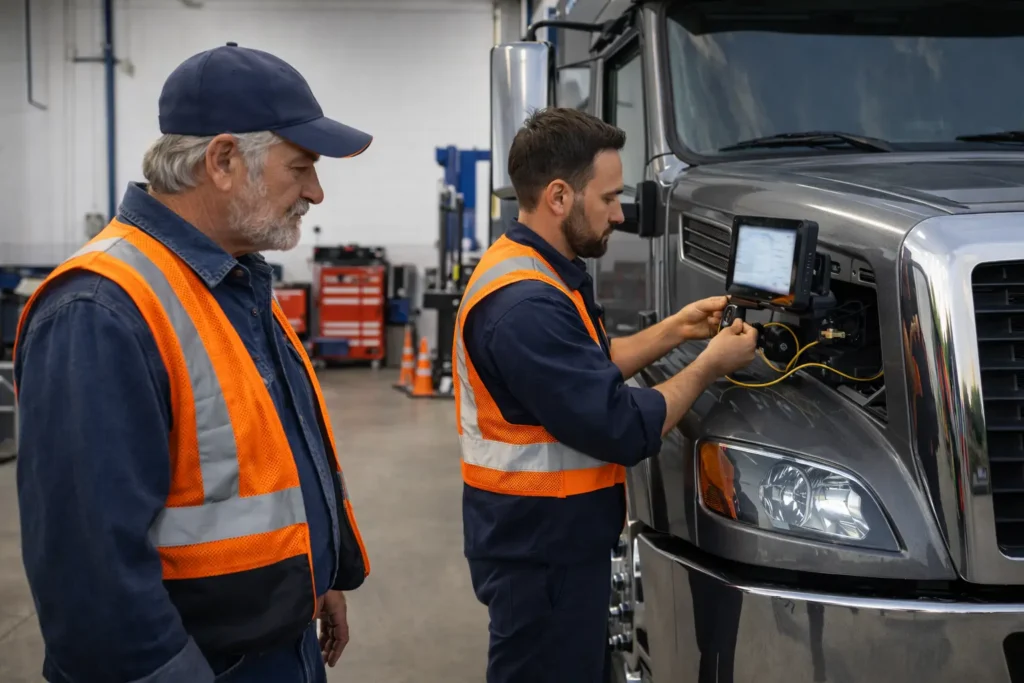
Experienced drivers tend to care less about superficial features than about uptime, comfort, and repair discipline. They want preventive maintenance completed on schedule, fast roadside coordination, clear breakdown procedures, and a realistic plan for extended shop stays. If a truck goes down, they want one team to own the problem rather than multiple departments shifting responsibility. They also notice whether the carrier makes practical investments that help them recover properly between driving periods.
FMCSA’s fatigue guidance is relevant here as well. The agency connects impaired alertness with crash risk and stresses the importance of adequate rest 1. Equipment features that preserve rest—such as dependable HVAC, power systems, and sleepers that function as intended—support the same safety goals carriers claim to prioritize. In that sense, equipment quality is not just an asset utilization issue. It is a safety and retention issue.
Maintenance communication matters almost as much as maintenance itself. Drivers can tolerate a mechanical issue more easily than an information vacuum. If the repair process includes quick triage, clear status updates, realistic estimates, and a backup plan when delays extend, trust can survive the disruption. If the driver is left waiting on unclear approvals and repeated phone calls, a repair becomes a symbol of organizational disorder.
How Can Carriers Build a Safety-First Culture That Drivers Believe?
A real safety-first culture does not begin with posters or training decks. It begins when a driver encounters weather, fatigue, securement concerns, or customer pressure and can make the safer decision without fearing retaliation. Veteran drivers pay close attention to this because they know the difference between a company that says safety comes first and one that proves it when the load is at risk.
FMCSA’s fatigue material makes the stakes plain. Drowsiness can impair reaction time, and being awake for 18 hours may create impairment comparable to a blood alcohol concentration of 0.08 percent 1. Those findings are directly relevant to dispatch planning and driver communication. If a driver says a weather delay, parking shortage, or customer hold has created an unsafe situation, the company’s response becomes a test of whether safety is truly operationalized.
A believable safety culture has several characteristics. Drivers have explicit authority to stop or delay when conditions are unsafe. Safety holds are documented clearly in the operating system so payroll and customer service can respond without ambiguity. Preventable pressures, such as unrealistic appointment commitments or punitive treatment of late deliveries, are addressed at the planning level rather than pushed onto the driver. And when incidents or close calls occur, leaders focus on process improvement, not reflexive blame.
The connection to retention is straightforward. Experienced drivers want to work where their judgment is treated as an asset. If the carrier undermines that judgment whenever a shipment is urgent, the company sends the message that production matters more than professionalism. That message travels quickly through driver networks.
What makes safety culture credible instead of performative?
Credibility comes from consistent consequences and consistent protections. If a driver can document a weather hold and still receive fair treatment, the culture is credible. If a driver refuses an unsafe load and leadership backs that decision in practice, the culture is credible. If safety language disappears the moment service pressure rises, drivers conclude that the culture is decorative.
How Should Back-Office Support Be Organized So Driver Problems Get Solved Fast?
The best support model is not necessarily the one with the most departments. It is the one that resolves exceptions quickly without forcing the driver to navigate internal complexity. Breakdowns, lumper approvals, permit questions, missing purchase orders, detention disputes, and last-minute parking problems all test whether the carrier’s support structure is designed around driver time or around internal silos.
What experienced drivers want is simple: first-contact problem solving whenever possible. A centralized 24/7 support model can deliver that well if notes, approvals, and escalation paths are unified. A decentralized dispatcher-led model can also work when ownership remains clear and handoffs are disciplined. The wrong model is any model in which drivers must explain the same issue repeatedly to different people while the clock keeps running.
Parking is a useful example. FMCSA’s truck parking research specifically highlights the costs of driving extra miles to find legal parking, stopping early because spaces may disappear, or parking in unauthorized locations 3. If operations support is weak, those costs fall directly on the driver. If operations support is strong, the carrier actively helps the driver protect time, compliance, and safety.
Detention and lumper workflows reveal the same principle. Standing authority within clear limits often protects driver time better than repeated approval calls. A well-designed system documents the event, gets the driver moving, and handles cost recovery in the background. A poorly designed system saves pennies in control but loses hours in dwell.
How Should Carriers Use Technology Without Making Drivers Feel Surveilled?
Technology is valuable when it reduces friction. It becomes destructive when it creates additional clicks, duplicate data entry, false timestamps, or a sense that every tool exists mainly to monitor rather than support the driver. Experienced drivers tend to welcome useful technology and reject intrusive or unreliable technology. The distinction depends on how the tools are implemented.
A driver-centered technology stack does four things well. It works in weak-signal environments. It eliminates redundant entry across dispatch, compliance, scanning, and payroll tools. It captures documents cleanly enough to speed settlement. And it uses data for coaching and process improvement rather than surveillance theater. When technology does those things, drivers experience it as support. When it fails at them, it becomes another source of friction.
This matters for retention because the average driver does not judge technology by vendor promises. Drivers judge it by whether the app loads in the yard, whether geofencing creates false arrivals, whether they must retype the same trailer number in three systems, and whether a blurry document upload delays pay. In other words, they judge it the same way they judge every other part of the operation: by how it affects time, clarity, and income.
A disciplined rollout therefore requires field testing, fallback workflows, role-specific training, and adoption measures that actually reflect driver experience. The best tools become almost invisible because they quietly remove paperwork, phone tag, and settlement delays.
How Do Respect, Recognition, and Career Growth Keep Veteran Drivers From Leaving?
Recognition matters most when it is attached to real control, real listening, and real growth. Veteran drivers can usually tell the difference between recognition that reflects operational respect and recognition that tries to compensate for operational disorder. Awards, gift cards, and appreciation campaigns are not meaningless, but they do not outweigh chronic unpredictability, unresolved payroll issues, or repeated home-time misses.
The more durable form of respect is structural. Drivers feel respected when their judgment is trusted, when safety holds are not punished, when endorsements or training are supported, and when promotion paths are visible. They also feel respected when their experience influences policy through driver councils, feedback loops, or direct participation in customer and scheduling reviews.
Health and work-design evidence adds weight to this point. NIOSH’s survey of 1,670 long-haul truck drivers found that 69 percent were obese compared with 31 percent of U.S. working adults, 51 percent were current smokers compared with 19 percent of the general working population, and 14 percent reported diabetes compared with 7 percent in the general population 5. Those numbers do not mean carriers can solve every structural challenge of trucking. They do mean that the work environment carries long-term consequences. Respect therefore includes reducing avoidable stressors and giving drivers more control where possible.
Career growth should be treated the same way. Reimbursing endorsements, clarifying trainer or specialized-freight pathways, publishing time-to-promotion bands, and connecting recognition to measurable safety and service performance all tell experienced drivers that the company sees them as long-term professionals rather than temporary seat-fillers.
What Should Carriers Prioritize Over the Next 12 to 24 Months to Improve Driver Experience?
The next phase of competition for experienced truck drivers will be shaped less by recruiting creativity and more by operational proof. Information now travels quickly through reviews, referrals, driver communities, and publicly available safety and industry data. That means carriers cannot rely on broad brand claims for long. They have to show evidence that the driver experience they advertise is the one they deliver.
The most important strategic move is to make the driver experience observable. Track home-time compliance. Track first-contact resolution. Track time to payroll correction. Track breakdown turnaround. Track detention capture and payout speed. Track how often planning pushes drivers into avoidable parking pressure. Once those measures are visible, teams can stop arguing in abstractions and start improving the actual work.
The second priority is simplification. Many fleets do not need more initiatives; they need fewer conflicting processes. Communication standards, pay clarity, maintenance coordination, customer planning, and technology workflows should reinforce one another rather than create extra handoffs. Experienced drivers stay longer when the operation feels coherent.
The third priority is to use data to defend driver time. That means confronting chronic high-dwell customers, aligning appointments more realistically, documenting safety holds consistently, and using technology to reduce friction rather than increase oversight. The carrier that protects driver time will increasingly outperform the carrier that merely advertises appreciation.
What Is the Bottom Line for Carriers That Want to Keep Experienced Truck Drivers?
The bottom line is that experienced truck drivers are not asking for perfection. They are asking for coherence. They want to work in a system where communication is complete, scheduling is honest, pay is understandable, equipment is dependable, safety decisions are supported, and support teams solve problems without drama. When those pieces are present, a carrier feels professional. When they are missing, even strong recruiting copy or a competitive headline rate cannot fully compensate.
That is why the most effective retention strategy is not a single program but a better operating model. Every improvement that protects driver time, lowers uncertainty, and increases control strengthens the same message: this carrier understands how the job actually feels from the driver’s seat. For veteran drivers, that message is the difference between a company that sounds good and a company worth staying with.
FAQs About What Experienced Truck Drivers Expect From a Carrier
What do experienced truck drivers look for in a carrier first?
Most experienced truck drivers look first at how the company operates in real life. They want clear communication, predictable freight, accurate pay, reliable equipment, and support that solves problems quickly. Those daily operating signals tell them more than recruiting language ever will.
Why is home time so important for truck driver retention?
Home time matters because it represents honesty and control. Drivers can accept demanding work when they trust the plan, but repeated home-time misses signal that the operation is unstable or that driver commitments are easy to break. That damages retention quickly.
How does pay transparency affect experienced truck drivers?
Pay transparency reduces the distrust created by unclear settlements and unresolved accessorials. When drivers understand how they are paid, when detention starts, how corrections work, and when disputes will be resolved, they are far more likely to view the carrier as fair and professionally run.
What kind of communication do truck drivers prefer from dispatch?
Most prefer complete load briefs, exception-based updates, and a single source of truth for approvals and changes. They do not want constant interruptions or fragmented messages. They want timely, useful communication that helps them make good decisions on the road.
Can better technology really improve truck driver retention?
Yes, when the technology removes friction instead of adding it. Tools that reduce paperwork, prevent duplicate entry, improve document capture, and preserve clean settlement workflows can improve the driver experience materially. Technology that behaves like surveillance or fails in the field usually has the opposite effect.
How can a carrier show drivers real respect instead of symbolic recognition?
A carrier shows real respect by protecting driver time, backing safety decisions, keeping pay clean, supporting growth, and listening to experienced drivers when policies are reviewed. Symbolic recognition can help, but it cannot replace operational credibility.