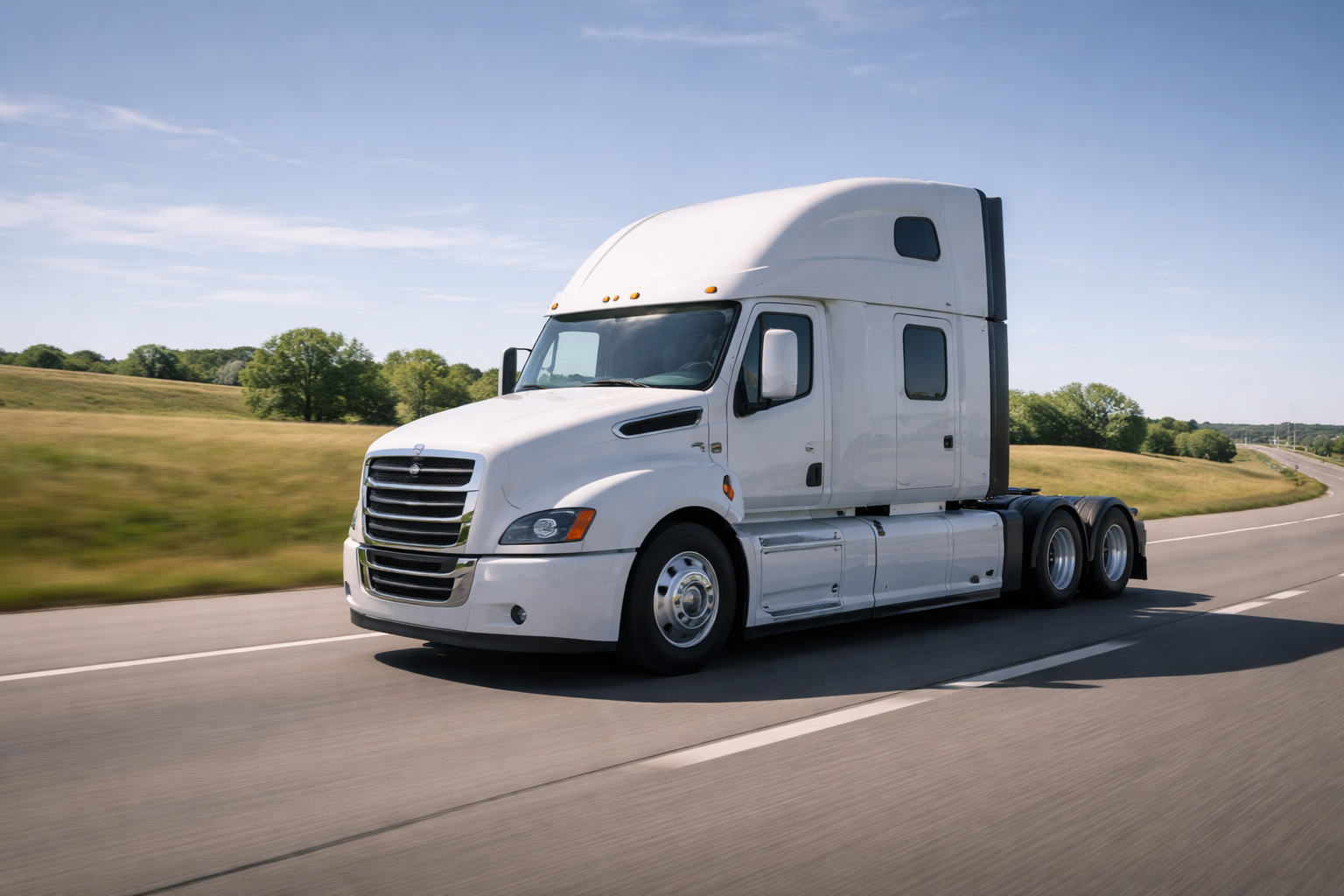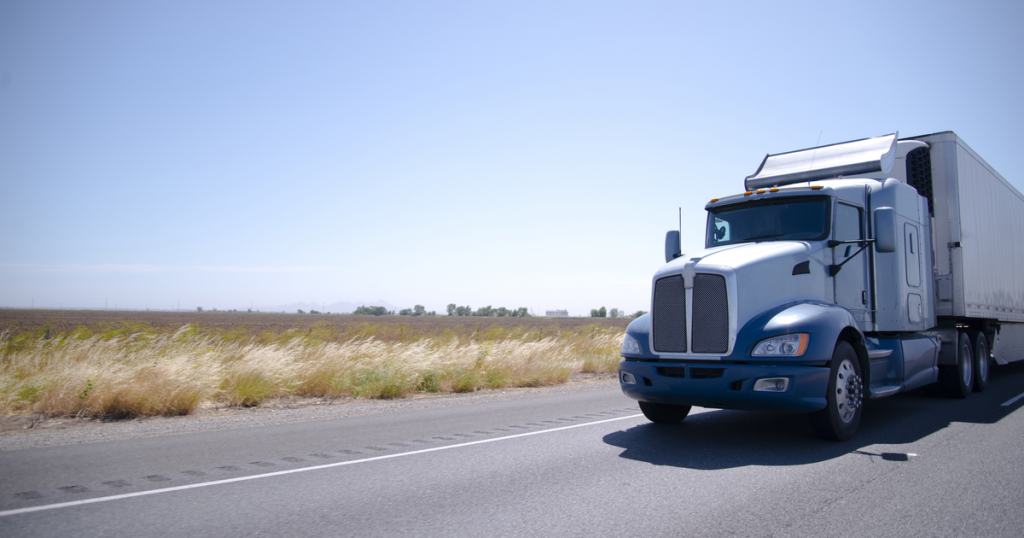
Fuel sits near the top of a fleet’s operating costs, and small changes in semi truck fuel economy move real dollars. On typical long‑haul duty cycles, tractors average 6–8 MPG. At 100,000 miles a year and $4.00 diesel, improving from 6.5 to 7.5 MPG saves roughly $8,200 per tractor, without adding a single load.
The path to those gains is practical: plan smarter routes to cut out‑of‑route miles and idle, spec and retrofit proven aero and powertrain tech, coach drivers on steady speed and gentle inputs, and maintain tires, alignment, and aftertreatment to keep resistance low. Expect clear KPIs, MPG by lane and tractor, idle percentage, harsh events, supported by telematics, fuel card data, and simple ROI math so decisions stand up in a budget review.
Before prioritizing investments, align on the fundamentals, what efficiency measures mean, how they’re tracked, and which variables matter most. We’ll start with definitions and the core factors that raise or drag down MPG, then build toward the specific actions that deliver durable savings.
Why Fuel Is the Most Controllable Cost in Trucking
Fuel is one of the few major operating costs fleets can actively manage every day. When fuel economy is treated as a decision lens, rather than a number reviewed after the fact, it brings alignment across routing, equipment selection, driver behavior, and maintenance. This shift in perspective matters because even modest efficiency gains compound significantly across miles, trucks, and years, turning small improvements into meaningful financial outcomes.
Understanding Fuel as a Controllable Cost
Fuel becomes “controllable” not because of price at the pump, but because of the many operational choices that determine how many gallons are consumed per mile. Decisions around lane selection, departure timing, speed management, and idle policies all influence fuel use. Equipment specifications, such as aerodynamics and tire selection, also play a role, as do maintenance practices that ensure engines and tires operate at peak efficiency.
Industry data reinforces just how important this is. Studies from the American Transportation Research Institute consistently show fuel accounting for roughly one-quarter to one-third of total marginal costs. In periods of high diesel prices, it is often the single largest expense. In practical terms, a tractor running 100,000 miles per year at 6.5 MPG will consume about 15,400 gallons of fuel, costing roughly $61,600 annually at $4.00 per gallon. Improving efficiency to 7.5 MPG reduces consumption to about 13,300 gallons, creating substantial savings when scaled across an entire fleet.
Core Metrics and Operational Context
At the center of fuel management are two simple metrics: miles per gallon and gallons per 100 miles (G/100). MPG is familiar and effective for communicating performance trends, while G/100 offers a more operational perspective by translating efficiency directly into gallons consumed over distance. This makes it easier to connect performance improvements to real cost savings.
However, these metrics only become meaningful when viewed within the context of a truck’s duty cycle. Factors such as terrain, weather, speed, payload, and trailer type all influence what “good” fuel economy looks like. A long-haul highway operation will naturally produce different results than a regional or heavy-haul application, so performance targets must reflect real operating conditions.
The Four Levers That Drive Fuel Economy
With that context in place, fuel economy can be broken down into four primary areas of control. Routing and network decisions shape how much time trucks spend in congestion, how often they idle, and how many empty miles they run. Vehicle technology influences drag and rolling resistance, directly affecting efficiency at speed. Driver behavior determines how the powertrain is used in real-world conditions, especially in traffic and varying terrain. Finally, maintenance ensures that the efficiency built into the equipment is preserved over time.
Applying an ROI Mindset
To make fuel management actionable, fleets should approach every improvement as an investment. Whether it’s adjusting a route to avoid congestion or installing an aerodynamic device, each decision should be evaluated based on expected gallons saved, cost per gallon avoided, and overall payback period. These economics will vary depending on operating conditions, so what works in one fleet may not translate directly to another. The key is consistency, measuring fuel in gallons, translating it into dollars, and prioritizing actions based on clear financial returns.
How to Improve Semi Truck Fuel Economy and Cut Fuel Spend
With measurement and KPIs in place, the next step is to focus on where miles are actually driven and how time is spent on the road. Fuel waste tends to accumulate through congestion, idle time, inefficient routing, and empty miles. Addressing these at the network level is one of the fastest ways to improve semi truck fuel economy, because it removes waste before requiring new equipment or capital investment.
Time-of-Day Departures and Lane Selection
Small changes in departure timing can significantly reduce exposure to congestion. Shifting loads out of peak traffic windows helps minimize idle time and stop-and-go driving while maintaining service levels.
In a 50-load pilot out of Chicago, moving departures from 7:30 a.m. to 9:30–10:00 a.m.:
- Reduced average idle by 32 minutes
- Improved MPG from 6.9 to 7.3 (~6% gain)
- Maintained on-time delivery
To scale this, use TMS data and historical traffic patterns to define preferred departure windows by lane, weekday, and season.
Planned Detours Around Bottlenecks
The shortest route is not always the most fuel-efficient. Consistent speeds often outperform stop-and-go traffic, even if the route is slightly longer.
Example:
- 8-mile detour at 7 MPG ≈ 1.14 gallons
- Avoiding ~25 minutes of congestion can save:
- 0.4–0.6 gallons of idle fuel
- Additional fuel lost to repeated acceleration
- 0.4–0.6 gallons of idle fuel
Pre-planning these detours improves both fuel efficiency and schedule reliability while reducing trip variability.
Dwell-Time Reduction and Appointment Discipline
Idle time at facilities is a hidden but significant fuel drain. Diesel engines typically consume ~0.8–1.1 gallons per hour at idle, meaning small reductions quickly add up.
Cutting 30 minutes of dwell across multiple weekly stops can:
- Save 2–3 gallons per tractor per week
- Reduce costs by ~$8–$12 weekly at $4.00/gal
- Improve schedule predictability
Key tactics include:
- Tighter, more realistic appointment windows
- Increased use of drop-and-hook operations
- Load pre-staging to reduce wait times
- Geofenced alerts for early arrivals and extended dwell
Backhaul Planning to Reduce Empty Miles
Deadhead miles burn fuel without generating revenue, making them one of the most direct opportunities for improvement.
For example:
- Reducing empty miles from 18% to 12% on 100,000 annual miles removes 6,000 empty miles
- At 7 MPG, that’s ~857 gallons saved (~$3,400 annually at $4.00/gal)
Effective strategies include:
- Securing consistent backhaul commitments
- Multi-stop load consolidation
- Regional lane swaps with partner fleets
- Integrating load boards directly into the TMS
Fuel and Service Stop Strategy
Fuel stops should be planned as part of the route, not added as detours. Off-route fuel discounts can quickly be erased by the cost of getting there.
Example:
- 4-mile detour at 7 MPG ≈ 0.57 gallons burned
- At a $0.10/gal discount, ~6 gallons must be purchased just to break even (before time costs)
Best practices:
- Align fuel and rest stops with primary routes and HOS breaks
- Use fuel price indexing to guide stop selection
- Implement out-of-route alerts to reduce unnecessary deviations
By reducing congestion, idle time, and empty miles at the network level, fleets create fuel savings that repeat across every load. These operational improvements compound quickly and require little to no capital investment.
Once this waste is removed, the next step is to optimize the truck itself, focusing on aerodynamics and rolling resistance to further reduce fuel consumption.
Choosing the Right Aerodynamics and Rolling Resistance for Your Lanes
Once waste has been removed from routes and schedules, the next opportunity sits in how the truck interacts with air and pavement. Equipment decisions that shape airflow and tire contact determine how efficiently diesel energy is converted into forward motion. The goal is not to chase the newest or most aggressive add-on, but to match each choice to real operating conditions so projected gains translate into measurable savings.
Aerodynamics: Where Speed Changes the Equation
Aerodynamic drag increases rapidly with speed, which is why the same device can produce very different results depending on the lane. A long-haul truck cruising at 65 mph will see far greater benefit from aerodynamic improvements than a regional truck averaging 35–40 mph in stop-and-go traffic.
Common aerodynamic components work together to reduce turbulence and drag:
- Trailer side skirts help smooth airflow beneath the trailer
- Rear devices reduce wake drag behind the trailer
- Tractor-trailer gap reducers and roof fairings limit turbulent air between units
- Wheel covers minimize drag from rotating tires
In steady highway conditions, trailer skirts often deliver mid single-digit percentage fuel savings, with rear devices adding incremental gains when consistently deployed. These benefits are amplified in crosswind conditions, where managing airflow around the trailer becomes even more important.
The key takeaway is simple:
- Higher, steady speeds → aerodynamics deliver stronger returns
- Lower, variable speeds → aerodynamic gains diminish
Rolling Resistance: The Constant Fuel Drain
Unlike aerodynamics, rolling resistance impacts fuel consumption at all speeds and becomes the dominant factor in lower-speed operations. Tires, alignment, and inflation determine how much energy is lost as the truck rolls down the road.
Low rolling resistance tires, particularly SmartWay-verified models, consistently deliver measurable improvements, often a few percentage points compared to standard options. These gains become even more reliable when paired with strong maintenance practices, including:
- Proper tire inflation
- Regular alignment checks
- Monitoring uneven wear and tire condition
Wide-base single tires can provide additional efficiency gains in the right applications, but the decision should consider traction requirements, axle load limits, and service availability, not just headline fuel savings.
A useful rule of thumb:
- Lower-speed or urban routes → prioritize tires and alignment
- Higher-speed highway routes → aerodynamics take the lead
Putting Numbers to the Investment
To make these decisions actionable, fleets should evaluate improvements using lane-specific data. Start with a real baseline, MPG, annual miles, and fuel cost, then apply realistic savings assumptions.
Example scenario:
- 100,000 miles per year at 6.8 MPG
- Diesel at $4.00 per gallon
- Annual fuel use ≈ 14,706 gallons
If trailer skirts deliver a conservative 3% improvement on that lane:
- Fuel saved ≈ 441 gallons annually
- Cost savings ≈ $1,764 per year
With an installed cost of ~$1,200 (plus minor maintenance), the payback falls well under a year. However, on a low-speed urban route, that same investment would yield smaller savings and a longer return timeline, making tire upgrades a better initial priority.
Speed, Payload, and Seasonal Effects
Real-world performance depends on more than just equipment. Speed bands, payload, terrain, and weather all influence outcomes:
- At 55–60 mph, aerodynamic gains are steady but moderate
- At 65–70 mph, drag increases sharply, amplifying aero benefits
- Heavier loads increase tire deformation, raising rolling resistance
- Mountain routes introduce variability, with aero gains strongest on faster segments
- Cold weather increases air density (helping aero slightly) but reduces tire pressure, increasing rolling resistance
Because of this, many fleets take a blended approach, standardizing low rolling resistance tires across all operations while concentrating aerodynamic investments on high-speed lanes.
Trailer Control and Real-World Execution
The effectiveness of aerodynamic investments often depends on trailer control. Fleets that rely heavily on drop-and-hook with third-party trailers may see limited returns from trailer-mounted devices. In these cases, tractor-based improvements, such as fairings and wheel covers, offer more consistent value.
Where fleets control their trailers, standardization becomes more viable, but execution matters. Savings can quickly erode if equipment is not maintained or used properly. Common issues include:
- Damaged skirts from docks or snowbanks
- Undeployed rear devices
- Missing or worn aerodynamic components
Driver awareness and routine inspections play a critical role in preserving expected gains.
A Practical Payback Approach
A disciplined ROI framework keeps decisions grounded and repeatable:
- Start with validated savings ranges from trusted sources or OEM data
- Adjust expectations based on lane speed, weather, and trailer control
- Convert percentage savings into gallons and dollars using real fleet data
- Subtract maintenance and repair costs
- Calculate payback period in months
As a general guideline, investments that return their cost within 12–24 months on target lanes should be prioritized. More uncertain cases can be piloted on a small subset of equipment before scaling.
Improving aerodynamics and reducing rolling resistance gives the truck a more efficient physical profile, lowering the energy required for every mile traveled. But hardware alone is not enough. To fully capture these gains, the powertrain must deliver torque efficiently and consistently under real-world conditions.
How to Configure Powertrains and Intelligent Controls for Better MPG
Powertrain settings determine how efficiently every drop of diesel is converted into motion. Improving fuel economy is not just about hardware, it is equally about how that hardware is configured and controlled. Gearing, shift logic, and speed policies can either turn terrain into usable momentum or waste energy through unnecessary braking, excess RPM, and inefficient acceleration. The goal is to translate these engineering levers into practical, repeatable settings that fleets can actively manage.
A real-world example illustrates how quickly these changes can add up. Midwest Refrigerated, operating 120 tractors, piloted three adjustments on its primary I-70 corridor: reducing governed speed from 68 to 65 mph, enabling predictive cruise with eCoast on rolling terrain, and updating AMT shift logic for earlier upshifts. Over 90 days and more than 6 million miles, fuel economy improved from 6.8 to 7.3 MPG, about a 7% gain, without impacting on-time delivery. Most of the improvement came from maintaining steady speeds and using terrain more effectively.
Governed Speed: Balancing Fuel and Time
Speed is one of the most direct and controllable drivers of fuel consumption. Even small reductions can produce meaningful savings:
- Reducing top speed by 3 mph typically saves 3–5% in fuel
- Adds roughly 3 minutes per 100 miles in transit time
- Schedule impact is minimal when appointments reflect the new operating speed
In practice, governed speed changes often deliver the largest single gain, especially on long-haul lanes where trucks spend extended time at cruise.
Downspeeding and Driveline Matching
Downspeeding, running the engine at lower RPM while maintaining road speed, requires the right combination of engine, axle ratio, and tire size. When properly matched, it keeps the engine operating in its most efficient range.
- Flat, highway-heavy routes → favor taller gearing for lower RPM
- Routes with frequent 3–5% grades → maintain enough ratio to avoid engine lugging
The key is balance: pushing RPM too low in hilly terrain can force excessive downshifting, negating efficiency gains.
Automated Manual Transmissions: Consistency at Scale
AMTs reduce variability between drivers and ensure consistent, fuel-efficient shifting. When calibrated correctly, they:
- Promote earlier upshifts and lower average RPM
- Skip gears when load and terrain allow
- Deliver typical fuel savings of 1–3% over manual transmissions
In the Midwest Refrigerated pilot, updated shift maps, favoring earlier upshifts and smoother torque delivery, produced measurable MPG gains while improving drivability.
Predictive Cruise and eCoast: Using Terrain as an Asset
Modern cruise systems leverage GPS and topographic data to optimize speed and momentum automatically. These systems:
- Slightly increase speed before climbs
- Reduce throttle near hill crests
- Coast on gentle descents to conserve fuel
On rolling terrain, fleets often see 1–4% fuel savings. In the pilot program, these features contributed a meaningful portion of the overall improvement, particularly on long, undulating highway segments.
Torque and Acceleration Management
Short bursts of aggressive acceleration can consume disproportionate amounts of fuel without improving overall trip time. Managing torque delivery helps smooth these inefficiencies:
- Limit peak torque in lower gears to reduce fuel spikes
- Use progressive pedal mapping to smooth acceleration
- Set grade-hold thresholds to avoid unnecessary downshifts
These adjustments reduce high-RPM events that quietly erode fuel economy over time.
Calibration Governance: Turning Changes Into Standards
To ensure lasting impact, powertrain settings should be managed with the same discipline as any operational policy. A structured approach includes:
- Testing one variable at a time
- Tracking MPG normalized for payload, terrain, and weather
- Using telematics data for weekly performance reviews
- Publishing validated configurations as standard profiles
In the example fleet, a controlled pilot group and consistent data review allowed leadership to confirm results before scaling changes across the operation.
Dialing in powertrain settings and intelligent controls establishes a reliable efficiency baseline that drivers can consistently achieve. With diesel configurations optimized, the next step is to evaluate where alternative fuels and electrified solutions fit within your network, based on lane structure, dwell time, and infrastructure readiness.

How to Train and Coach Drivers for Better Fuel Economy
Even the best equipment and routing strategies will fall short if driver programs are not designed thoughtfully. In many fleets, the biggest gaps in fuel economy come not from technology limitations, but from how performance is measured, coached, and incentivized. The most common issues are not obvious at first, they stem from misaligned metrics, inconsistent follow-through, or incentives that unintentionally encourage the wrong behaviors. Addressing these pitfalls is what turns short-term gains into durable, fleet-wide improvements.
Apples-to-Oranges Driver Comparisons
One of the most common mistakes is ranking drivers using raw MPG without accounting for operating conditions. A driver hauling heavy loads through mountain terrain cannot reasonably compete with one running lighter freight on flat highways. When comparisons feel unfair, drivers disengage because the outcome appears outside their control.
To correct this, performance should be normalized across comparable conditions. Group drivers by lane type, payload range, terrain, and even seasonal factors, then evaluate performance within those cohorts. Metrics like gallons per 100 miles, idle percentage, overspeed time, and cruise utilization provide a more accurate picture. Just as importantly, recognize improvement trends, not just top performers, so every driver has a clear, achievable path to success.
One-and-Done Training with No Follow-Through
Initial training programs often fade quickly without reinforcement. Drivers may complete onboarding or annual refreshers, but without consistent coaching, habits drift and newer features, such as predictive cruise or optimized AMT settings, go underutilized.
A more effective approach is to build a regular coaching rhythm. Short monthly refreshers, combined with targeted ride-alongs or simulator sessions, help reinforce high-impact behaviors like steady throttle control and anticipatory braking. Telematics data can guide quick microlearning sessions tied to recent exceptions. Assigning one clear goal per driver each month, such as reducing time above a certain speed, keeps the focus manageable and measurable, while short check-ins ensure accountability.
Punitive Leaderboards That Backfire
Public rankings and winner-take-all incentives can unintentionally drive unsafe or counterproductive behavior. Drivers may attempt to “game” the system, coasting in neutral, avoiding necessary HVAC use, or taking other risks, to improve their numbers. This not only undermines safety but can damage morale and retention.
A more sustainable model balances fuel efficiency with safety and service metrics. Coaching should be private and constructive, while rewards can be structured around team or cohort improvement. Clear guardrails are essential: explicitly prohibit unsafe practices such as drafting or neutral coasting, and allow for documented exceptions when conditions like weather or heavy loads impact performance.
Ignoring Feature Utilization and Configuration Gaps
Scorecards often highlight low usage of features like cruise control without addressing whether drivers understand how to use them, or whether the truck is configured correctly. Differences across model years can further complicate adoption.
Closing this gap requires truck-specific training and clear in-cab guidance. Demonstrate how features like predictive cruise behave on real routes, then track usage metrics such as time in cruise or fuel-saving modes. At the same time, verify that vehicle settings, like cruise offsets or engine brake configurations, support the behaviors being encouraged. Alignment between training and configuration is critical for consistent results.
Fuel Targets That Conflict with Operations
Fuel goals that ignore real-world constraints can create tension between efficiency and service. A strict speed cap or aggressive MPG target may not be realistic for lanes with tight delivery windows or high-speed traffic flow, leading drivers to either miss appointments or disregard the policy altogether.
The solution is to align fuel targets with operational planning. Work with dispatch to define speed ranges by lane, adjust departure times where needed, and measure performance within those parameters. Tracking “time in target speed range” is often more practical than enforcing a single hard limit, allowing drivers to balance efficiency with on-time delivery.
Over-Focusing on MPG Instead of Behavior
MPG is an important outcome, but it is influenced by many external factors such as weather, terrain, and freight mix. Focusing solely on this number can obscure the behaviors that actually drive improvement.
A stronger approach combines outcome metrics with behavior-based indicators. Track MPG and gallons per 100 miles, but coach drivers on controllable actions like idle time, acceleration patterns, and gear usage. Many fleets see a significant performance gap between top and bottom drivers operating under similar conditions. Closing that gap starts with identifying and coaching the specific behaviors that create it.
Avoiding these common pitfalls makes driver performance programs more credible, actionable, and fair. When drivers understand expectations, trust the measurement system, and receive consistent coaching, they are far more likely to adopt fuel-efficient habits. The result is a tighter alignment between the truck’s technical capabilities and real-world performance, delivering steady, repeatable gains in fuel economy across the fleet.
Semi Truck Fuel Economy: FAQs
What is semi truck fuel economy, and why is it controllable?
Semi truck fuel economy, typically measured in miles per gallon, reflects how far a truck can travel on a gallon of diesel. What makes it especially important is that it is highly controllable. Unlike fuel prices, which fluctuate externally, fuel consumption is driven by daily operational decisions, routing, speed, idle time, driver behavior, equipment specifications, and maintenance.
Even small improvements compound quickly. For example, increasing efficiency from 6.5 to 7.5 MPG over 100,000 miles at $4.00 per gallon saves roughly $8,200 per truck annually. When fleets treat fuel economy as a decision-making lens rather than a passive result, they gain direct control over one of their largest operating costs.
MPG vs. Gallons per 100 Miles: When to Use Each
MPG is the most familiar metric and works well for tracking performance trends and communicating results. However, gallons per 100 miles (G/100) provides a more operational perspective by showing how much fuel is actually consumed over a fixed distance.
For example:
- 6.8 MPG ≈ 14.7 G/100
This makes it easier to calculate savings and ROI. MPG is best for high-level reporting, while G/100 is more useful for day-to-day decision-making and evaluating improvements in terms of gallons and dollars.
What factors influence fuel use?
Fuel consumption is shaped by four core areas:
- Routing and network design: congestion, idle time, empty miles, and out-of-route driving
- Vehicle technology: aerodynamics and rolling resistance
- Driver behavior: speed, throttle control, and cruise usage
- Maintenance: tire condition, alignment, engine performance, and aftertreatment systems
Each of these factors can either reinforce or erode fuel efficiency, depending on how they are managed.
How do you build a practical fuel efficiency plan?
Improving fuel economy starts with consistent measurement and a structured approach:
- Track MPG and G/100 alongside key context metrics like idle rate, overspeed time, and cruise utilization
- Remove network inefficiencies first by optimizing routes, departure times, dwell, and empty miles
- Match equipment to operating conditions, tires and alignment for lower-speed routes, aerodynamics for highway lanes
- Configure powertrains with appropriate speed policies, gearing, and shift logic
- Reinforce improvements through driver coaching and consistent maintenance
An ROI mindset, measuring gallons saved and cost per mile, keeps efforts focused and scalable.
What are the benefits and tradeoffs of aerodynamic upgrades?
Aerodynamic improvements reduce drag and are most effective at higher, steady speeds. Common upgrades include trailer skirts, rear devices, gap reducers, roof fairings, and wheel covers.
On long-haul routes:
- Trailer skirts can deliver mid single-digit percentage fuel savings
- Rear devices add incremental gains when consistently deployed
However, these upgrades come with tradeoffs: potential damage, the need for proper usage (especially rear devices), and reduced effectiveness on low-speed urban routes. If trailer control is limited, tractor-based aerodynamic improvements often provide more reliable returns.
How does rolling resistance affect fuel economy?
Rolling resistance is the energy lost as tires interact with the road, and it impacts fuel use at all speeds, especially in lower-speed operations where aerodynamics matter less.
Key practices to reduce rolling resistance include:
- Using low rolling resistance, SmartWay-verified tires
- Maintaining proper tire inflation
- Performing regular alignment checks
- Addressing uneven wear early
Wide-base single tires can offer additional gains in certain applications, but decisions should factor in traction, load limits, and service availability.
How do speed policies and powertrain choices impact fuel use?
Speed is one of the most influential variables in fuel consumption. Reducing governed speed by just a few miles per hour can cut fuel use by 3–5%, with minimal schedule impact when operations are aligned.
Other key factors include:
- Downspeeding: lowering engine RPM with matched gearing for efficient cruising
- Automated manual transmissions: reducing variability and improving shift efficiency (1–3% gains)
- Shift logic and calibration: ensuring the engine operates in its optimal range
The best results come from aligning speed policies, gearing, and transmission behavior with real-world operating conditions.
What makes a driver performance program effective?
A strong driver program is built on fairness, clarity, and consistency. Comparing drivers without context, such as lane type or payload, leads to disengagement. Instead, normalize performance by operating conditions and focus on behaviors drivers can control.
Effective programs:
- Track both outcomes (MPG, G/100) and behaviors (idle, speed, acceleration)
- Use private, constructive coaching rather than public rankings
- Set one clear, achievable goal per driver at a time
- Align incentives with safety and on-time performance
Clear guardrails should also prevent unsafe practices like drafting or neutral coasting.
What misconceptions limit fuel savings?
Several common assumptions can hold fleets back:
- Believing fuel costs are mostly driven by pump price rather than controllable usage
- Assuming the shortest route is always the most efficient
- Ranking drivers by raw MPG without context
- Relying on one-time training instead of ongoing coaching
- Chasing off-route fuel discounts that are offset by extra miles
A more effective approach focuses on controllable gallons per mile, steady-speed routing, normalized performance metrics, and consistent driver engagement.
What trends are shaping fuel efficiency in trucking?
Fuel efficiency is increasingly driven by technology and data. Advances in predictive cruise, eCoast, and refined transmission logic are delivering steady gains without major hardware changes. Tire technology, TPMS, and alignment analytics are helping fleets manage rolling resistance more precisely.
At the same time:
- Telematics are enabling more accurate ROI tracking and decision-making
- Alternative fuels and electrification are growing where infrastructure and duty cycles allow
- Diesel optimization remains the fastest, most reliable path to savings for many fleets
The overall trend is clear: fleets that combine data, technology, and disciplined execution are achieving the most consistent improvements in fuel economy.