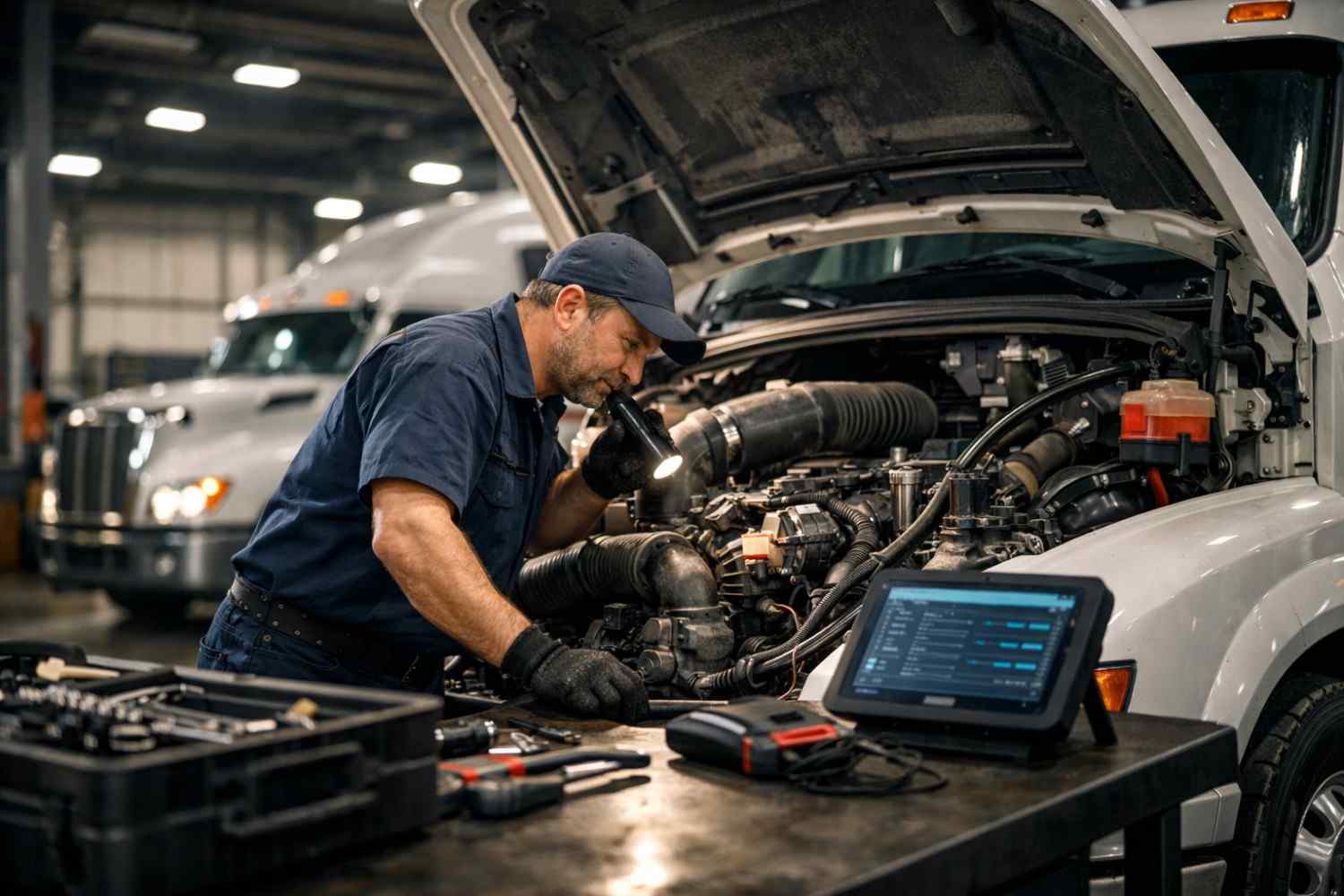
Semi truck maintenance isn’t just another line item, it’s one of the largest and most constant expenses in any trucking operation, and it directly determines whether your business stays on the road or sits idle. Every mile adds wear, every load adds strain, and every overlooked issue risks turning into costly downtime or a serious safety hazard. For owner-operators especially, maintenance isn’t optional or occasional, it’s the backbone of profitability, compliance, and long-term equipment value.
This guide breaks down the full maintenance landscape system by system, giving you a clear view of what it actually costs to keep a semi truck in top condition. From engine and transmission work to tires, brakes, and preventive service, we’ll outline realistic price ranges based on real-world scenarios, not just best-case estimates. The goal is to remove guesswork so you can anticipate expenses instead of reacting to them.
By the end, you’ll have more than just a list of repairs, you’ll walk away with a cost-aware maintenance checklist and a practical budgeting framework designed specifically for semi truck maintenance. Whether you’re planning for the year ahead or tightening margins in a tough market, this will help you stay compliant, avoid surprises, and keep your truck earning instead of parked.
The Cost Anatomy of Semi Truck Maintenance
The true cost of semi truck maintenance isn’t defined by a single repair, it’s shaped by a combination of variables that can swing the price of the exact same job by thousands of dollars. Understanding these cost drivers is what separates reactive spending from strategic budgeting.
First, age and mileage play a major role. A newer truck running under warranty may only need routine service, while a high-mileage unit (500,000+ miles) is far more likely to face major component replacements like injectors, turbochargers, or even an engine overhaul. Closely tied to this duty cycle, a truck hauling heavy loads daily or operating in stop-and-go conditions will wear components much faster than one running steady highway miles.
Your routes and climate matter more than most operators realize. Mountain driving increases strain on brakes and transmissions, while extreme heat accelerates tire wear and cooling system issues. Cold climates, on the other hand, can impact batteries, fuel systems, and startup reliability. Two identical trucks operating in different regions can have dramatically different maintenance profiles.
Then there’s the external pressure of parts inflation and supply chain variability. The cost of critical components, like DEF sensors, EGR valves, or brake assemblies, has fluctuated significantly in recent years. Pair that with rising shop labor rates, and repair bills can escalate quickly. Labor rates now commonly range from $110 to $180 per hour, depending on region and shop type, with metropolitan areas often at the higher end.
To make sense of these variables, it helps to shift your mindset from one-off repair costs to performance metrics like cents per mile and labor cost per hour. According to the American Transportation Research Institute, maintenance and repair costs typically fall in the range of ~15 to 20 cents per mile, though older equipment or severe-duty operations can push that even higher.
Here’s how that translates into a practical annual budget:
- At 100,000 miles/year → $15,000 to $20,000 in maintenance
- At 120,000 miles/year → $18,000 to $24,000 in maintenance
These figures include both preventive maintenance (oil changes, inspections, tires) and unexpected repairs. When labor is factored in, especially for major jobs requiring 10–40 hours, the total cost can climb rapidly.
The key takeaway is that semi truck maintenance isn’t random, it’s measurable and predictable when broken down correctly. By understanding your truck’s operating conditions and tracking costs in CPM, you can build a realistic annual budget, identify trends early, and avoid the financial shock of unplanned downtime.
Preventive Maintenance Schedules, Fluids, and Filters
Preventive maintenance is where smart operators win, or lose, money. Staying on schedule keeps small, predictable costs from turning into major, high-dollar failures. Most fleets and owner-operators follow a tiered system, PM A, PM B, and PM C, each building on the last with deeper inspections and service intervals.
- PM A: Frequent, Foundational Service
- Typical interval: Every 10,000–20,000 miles
- Estimated cost: $300–$600
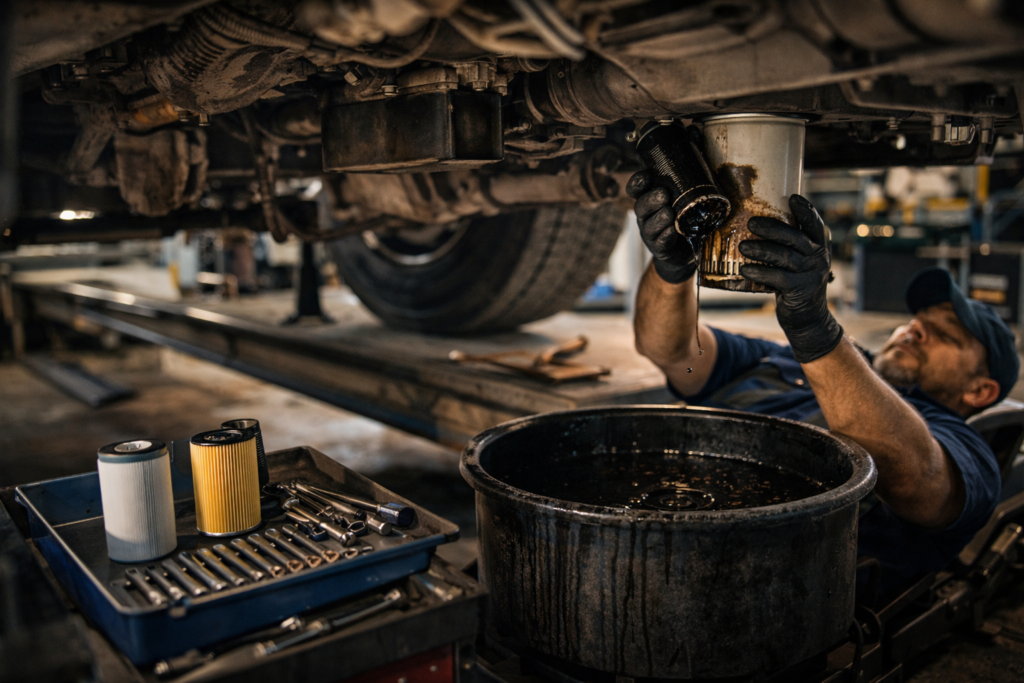
This is your most common service and the backbone of engine health: engine oil and filter change, chassis lubrication, fluid level top-offs, and a basic safety inspection (lights, hoses, belts). PM A keeps your engine protected and catches early wear before it escalates.
- PM B: Intermediate Inspection & Replacement
- Typical interval: Every 20,000–40,000 miles
- Estimated cost: $500–$900
Includes everything in PM A, plus fuel filter replacement, air filter inspection/replacement, brake inspection and adjustment, battery and charging system check, and a more detailed undercarriage inspection. PM B goes beyond fluids, it’s about identifying wear patterns and preventing system failures.
- PM C: Comprehensive Service
- Typical interval: Every 60,000–100,000 miles
- Estimated cost: $900–$1,500
This is your deep-dive service: all PM A + PM B items, full system diagnostics, driveline inspection and adjustments, wheel-end checks, alignment checks, and preventive component replacements as needed. PM C is where you reset the truck’s baseline condition and prevent catastrophic failures.
Key Fluid Services (Often Overlooked)
Fluids are the lifeblood of your truck, and skipping these services is one of the fastest ways to turn routine maintenance into major repairs. Coolant flushes typically run $200–$400 and help prevent overheating, corrosion, and liner pitting. Transmission service generally costs $250–$500, while differential service falls in a similar $250–$500 range, both critical for preventing gear wear and drivetrain failure.
Mini Cost Snapshot
- PM A: $300–$600 (every 10k–20k miles)
- PM B: $500–$900 (every 20k–40k miles)
- PM C: $900–$1,500 (every 60k–100k miles)
- Coolant Flush: $200–$400
- Transmission Service: $250–$500
- Differential Service: $250–$500
OEM Intervals & Oil Types
Keep in mind that intervals can vary significantly based on OEM recommendations and oil type. Trucks running standard oil typically stick to shorter intervals (around 15,000 miles), while long-drain synthetic oils, paired with proper filtration and oil analysis, can safely extend intervals to 25,000 miles or more. However, extended intervals only work when supported by consistent monitoring; otherwise, they can increase long-term wear.
Consistent PM is one of the highest-ROI decisions you can make. Spending a few hundred dollars on schedule can save you thousands in engine, transmission, or aftertreatment repairs, and keep your truck generating revenue instead of sitting in the shop.
Tires, Alignment, and Suspension Geometry
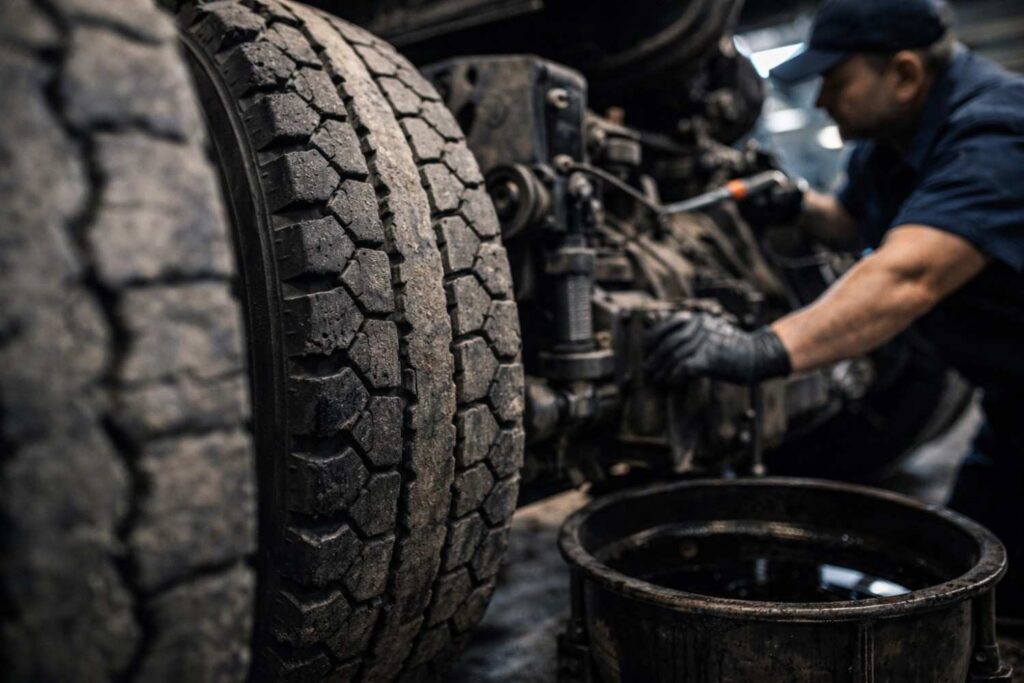
Tires are one of the most visible, and volatile, cost centers in semi truck maintenance. Unlike many components, they wear continuously, are directly impacted by driving conditions, and can quietly drain profits through poor fuel economy or uneven wear. Understanding tire economics means looking beyond purchase price and focusing on total cost of ownership.
Core Tire Costs (Per Unit & Service)
- Steer tires: $350–$700 each
- Drive tires: $300–$600 each
- Full set replacement: $3,000–$6,000
- Repair/patch: $30–$50
- Balancing/alignment: $200–$350
- Recaps (retreads): $150–$250 per tire
Steer tires typically demand premium pricing because they impact handling and safety, while drive tires offer more flexibility, this is where recaps often make the most economic sense. Recaps are commonly used on drive axles for long-haul operations where road conditions are consistent and predictable. However, they’re less ideal for steer positions or severe-duty routes (construction, off-road, sharp debris exposure) where failure risk is higher.
The Hidden Multiplier: Alignment & Suspension
Tires don’t wear in isolation, alignment and suspension geometry directly control how fast your tire investment disappears. Misalignment can scrub thousands of miles off a tire’s life, while worn suspension components quietly compound the problem. Key components and typical costs include shocks ($150–$300 each), bushings ($150–$300 per set/location), and airbags ($200–$400 each).
When these parts wear out, they cause uneven tire contact with the road, leading to irregular wear patterns like cupping, feathering, or edge wear. That not only shortens tire life but also increases rolling resistance, which reduces fuel efficiency. Even a small alignment issue can cost you 1–3% in fuel economy, adding thousands in annual fuel spend.
Tire Reserve: Cost Per Mile Strategy
To avoid large, unpredictable expenses, many operators budget tires using a per-mile reserve of about 3 to 6 cents per mile. At 100,000 miles per year, that translates to roughly $3,000–$6,000 annually dedicated to tires, aligning closely with real-world replacement costs depending on conditions and maintenance practices.
New vs. Recap Tires: Total Cost of Ownership
For long-haul highway routes, recaps offer strong value due to consistent wear patterns, lower upfront cost ($150–$250 vs. $300–$600), and the ability to retread quality casings multiple times, making them ideal for drive axles and lowering cost per mile. For regional or mixed routes, a balanced approach works best: new tires on steers and a mix of new and recaps on drives.
In severe-duty, off-road, or urban stop-and-go environments, new tires are typically the better choice due to higher damage risk reducing recap lifespan; the added durability offsets the higher upfront cost. A simple lifecycle comparison shows new-only strategies carry higher upfront costs with fewer usable life cycles, while recap strategies reduce total cost per mile when conditions support casing reuse.
Brakes and the Compressed Air System
Brakes are a safety-critical system where maintenance isn’t optional, it’s directly tied to stopping distance, inspection compliance, and your ability to stay on the road. The two primary setups, drum and disc, come with different cost structures, service intervals, and performance characteristics, and understanding those differences helps you plan both maintenance and risk.
Drum vs. Disc: Service Reality & Cost
- Drum brake reline (per axle): $500–$1,000 all-in
- Full tractor-trailer drum service: $1,000–$2,500+
- Disc brake pads & rotors (per axle): $800–$1,600
Drum brakes are more common and generally cheaper upfront, but they require more frequent adjustment and are more prone to heat-related fade under heavy use. Disc brakes, while more expensive per service, offer better stopping performance, improved heat dissipation, and more consistent braking, especially in demanding conditions. Over time, discs can reduce downtime and improve safety margins, particularly for fleets running heavy or mountainous routes.
Air System Components & Maintenance Costs
Your braking system depends entirely on compressed air, so neglecting the air system can disable your brakes even if pads and linings are in good shape. Key maintenance items include air dryer cartridges ($50–$150), which remove moisture and prevent corrosion and freezing; slack adjusters ($100–$200), which maintain proper brake stroke and must function correctly to avoid violations; and valves and sensors ($50–$250), which control and monitor system pressure. These components are relatively inexpensive individually but critical to system reliability.
Inspection Cadence & CSA Risk
Brake and air system inspections should happen at every PM interval, with visual checks even more frequently. Out-of-adjustment brakes, air leaks, or contaminated air systems are among the most common reasons for CSA violations and roadside out-of-service orders. Because braking issues are categorized as high-severity safety violations, they can immediately sideline your truck and impact your safety score, insurance rates, and revenue.
Stopping Distance & Safety Impact
Properly maintained brakes don’t just pass inspections, they save lives. Worn linings, poor adjustment, or air pressure issues can significantly increase stopping distance, especially under load. Even a small reduction in braking efficiency can mean the difference between a controlled stop and a collision, particularly at highway speeds.
Cost of Neglect: Real-World Scenario
Skipping routine brake maintenance might save a few hundred dollars in the short term, but the downstream cost can be substantial. For example, a truck placed out-of-service during a roadside inspection for brake violations can lose a full day (or more) of revenue, incur repair costs on the spot, and potentially face towing or emergency service fees at premium rates. What could have been a $600 scheduled reline can quickly escalate into a $2,000+ event when factoring in downtime, expedited repairs, and lost loads.
Brake and air system maintenance is one of the highest-impact areas of your operation. Staying ahead of wear and ensuring proper air system function not only controls costs, it protects your uptime, your CSA score, and everyone on the road.
Engine Health and Aftertreatment Systems
Your engine is the most expensive asset on the truck, and the aftertreatment system is what keeps it compliant. Together, they represent the highest-risk, highest-cost category in semi truck maintenance, where small, proactive investments can prevent five-figure failures.
Routine engine care is relatively affordable and highly effective at extending engine life. A valve and overhead adjustment typically costs $300–$700 and ensures proper timing, fuel efficiency, and combustion balance. Fuel system filter replacements run $50–$150 and are critical for protecting injectors from contamination. These services, when done on schedule, help maintain performance and prevent uneven wear across cylinders.
When maintenance is deferred, costs escalate, Injector replacement can run $2,000–$4,000 for a full set, while a failed turbocharger typically costs $1,500–$3,500. At the extreme end, an inframe overhaul, a full internal engine rebuild, can range from $20,000 to $40,000, often triggered by prolonged wear, oil contamination, or neglected warning signs.
On the emissions side, modern diesel trucks rely on a complex aftertreatment system that includes the DPF, DOC and SCR. Routine DPF cleaning costs $300–$700 and is essential for preventing soot buildup that can restrict exhaust flow. If components fail, replacement costs rise quickly: DPF or DOC units can run $1,500–$4,000+, while an SCR catalyst can reach $3,000–$8,000. Supporting components like DEF heaters and pumps typically cost $200–$800, but failures here can still trigger performance issues and compliance problems.
The biggest operational risk with aftertreatment systems is engine derate, when the truck automatically reduces power due to emissions faults. Common warning signs before a derate include frequent or forced regens, loss of fuel efficiency, warning lights related to DEF or emissions, and reduced engine performance. Acting early, cleaning the DPF, checking sensors, or addressing DEF system issues, can prevent being forced into limp mode on the road.
One of the most effective tools for proactive engine maintenance is oil sampling. Regular oil analysis provides a snapshot of engine health and can catch problems long before they become visible. Key data points to monitor include:
- Soot levels: Indicate combustion efficiency and potential DPF or injector issues
- Metal content (iron, copper, aluminum): Signals internal wear of engine components
- Fuel dilution: Points to injector leaks or incomplete combustion
- Coolant contamination: Suggests gasket or liner issues
By tracking these indicators over time, you can make informed maintenance decisions, scheduling repairs when they’re manageable instead of reacting to breakdowns. In the context of semi truck maintenance, this is the difference between a few hundred dollars in diagnostics and tens of thousands in major repairs.
Driveline, Transmission, and Axles
The driveline is what turns engine power into motion, and when something goes wrong here, it rarely stays isolated. Small issues, especially vibration or misalignment, can cascade across components, turning minor repairs into major failures. Understanding the cost structure and early warning signs is key to controlling long-term semi truck maintenance expenses.
Routine service starts with fluid changes and inspections for both manual and automated manual transmissions, typically costing $250–$500. Clean fluid reduces heat and wear inside the gearbox and helps prevent premature failure. Clutch replacements, a common wear item in manual setups, range from $2,000–$4,500 depending on labor and component quality.
Further down the driveline, U-joints and carrier bearings are relatively inexpensive individually, about $200–$500 each, but they play a critical role in maintaining smooth power transfer. When these components wear, they introduce vibration that stresses the entire system. Differential service costs vary widely, with reseals on the lower end and full rebuilds ranging from $1,000 to $5,000, especially if internal gears are damaged.
The Hidden Cost Driver: Vibration & Misalignment
Vibration is the early warning signal most operators overlook. A slightly worn U-joint or improper driveline angle can create harmonic vibration that compounds over time. This doesn’t just affect ride quality, it accelerates wear on transmission output shafts, differential gears and bearings, seals and yokes, even engine mounts in severe cases.
Driveline angle misalignment, often caused by worn suspension components or improper ride height, can rapidly destroy U-joints and lead to repeated failures if not corrected at the root.
Quick Decision Tree: Noise & Vibration Diagnostics
- Vibration under acceleration only: Likely U-joint wear or driveline angle issue
- Vibration at steady highway speed: Possible imbalance, carrier bearing wear, or driveshaft issue
- Clunking when shifting or taking off: Worn U-joints or excessive driveline play
- Whining or howling from rear: Differential gear wear or low/contaminated fluid
- Grinding during shifts: Clutch wear or transmission synchronizer issues
Identifying when and how the symptom occurs helps narrow down the source before it spreads damage further down the line.
Electrical, HVAC, and Driver-Comfort Systems
Electrical and comfort systems may not seem as critical as the engine or brakes, but they’re among the most common causes of unexpected downtime. A no-start condition, charging failure, or HVAC issue can sideline a truck just as quickly as a mechanical breakdown, often with less warning.
High-frequency, moderate-cost electrical failures are especially important to monitor. Batteries typically cost $100–$200 each, and most trucks run 3–4 units, making a full replacement $300–$800. Alternators range from $300–$700, while starters fall between $400–$900. Wiring and harness faults are harder to predict, diagnostic labor alone can run $150–$500, depending on how complex the issue is. These problems can be intermittent and time-consuming to trace, which increases labor costs quickly.
HVAC systems are another critical area, especially for driver comfort and compliance during long hauls. An A/C recharge typically costs $150–$350, while a compressor replacement ranges from $400–$1,200. Smaller components like blend doors and sensors fall in the $100–$400 range but can still impact system performance significantly. For trucks equipped with an APU, routine service runs about $150–$300, while major repairs can range from $500–$2,000, depending on the issue. Keeping the APU in good condition reduces engine idle time and long-term wear.
One of the most overlooked electrical risks is parasitic battery draw, when a component continues to pull power after the truck is shut off. Over time, this can drain batteries and lead to no-start situations. Testing for parasitic draw during inspections can identify faulty circuits or components before they cause downtime.
Modern telematics systems add another layer of protection by monitoring battery voltage trends, charging performance, and fault codes in real time. These systems can flag weakening batteries or alternator issues early, allowing you to schedule maintenance before a roadside failure occurs.
The takeaway: electrical and comfort systems may not always be top of mind, but they’re frequent failure points with real operational impact. Staying ahead of these moderate-cost items helps prevent costly delays, missed loads, and driver dissatisfaction.
Budgeting, Parts Strategy, and Shop Decisions
Turning maintenance costs into a predictable plan starts with one simple rule: budget by the mile, not by the breakdown. A practical range for most operations is 12 to 20 cents per mile for maintenance and repairs, adjusted based on truck age, application, and route severity. Newer trucks on steady highway routes may sit closer to 12–14 CPM, while older equipment or severe-duty operations can push 18–20+ CPM. This approach smooths out cash flow and ensures you’re financially prepared for both routine service and unexpected failures.
Parts Strategy: OEM vs. Aftermarket vs. Reman
Not all parts are created, or priced, the same, and your strategy here directly impacts both uptime and long-term cost. OEM (original equipment manufacturer) parts typically carry the highest price but offer the best fit, reliability, and warranty support, making them ideal for critical systems like engine components or aftertreatment. Aftermarket parts are usually more affordable and widely available, with quality ranging from excellent to inconsistent; they can be a smart choice for non-critical components if sourced from reputable brands. Remanufactured (reman) parts sit in the middle, rebuilt to OEM specs at a lower cost, often with solid warranties, making them a strong value option for items like turbos, injectors, and transmissions. The key is matching part type to risk: save on low-risk items, invest in high-impact components.
In-House vs. Outsourced Labor
Labor is one of the fastest-growing maintenance costs, with shop rates typically running $120–$180 per hour depending on region and facility. In-house maintenance can reduce hourly costs and improve turnaround time, but it requires investment in technicians, tools, and management. Outsourcing to a dealer or independent shop provides expertise and often stronger warranty backing on both parts and labor, but at a premium. The decision often comes down to scale: smaller operators benefit from outsourcing, while larger fleets can justify in-house capabilities for routine work. A hybrid model, handling PMs internally and outsourcing major repairs, is common and effective.
Downtime Calculator: The Hidden Cost
The biggest expense in trucking isn’t always the repair, it’s the time off the road. A simple way to quantify this is:
- Lost revenue per day = average daily miles × revenue per mile
For example:
- 500 miles/day × $2.50/mile = $1,250/day lost revenue
Now factor in a 2–3 day repair delay, and a “$1,500 repair” quickly becomes a $4,000–$5,000 total impact. This is why faster turnaround, parts availability, and shop efficiency often matter more than saving a few hundred dollars upfront.
Vendor Scorecard: Prioritize Reliability Over Price
Choosing the right shop or supplier isn’t just about the lowest quote, it’s about consistency and uptime. A simple vendor scorecard can help you make better decisions over time:
- Turnaround Time: How quickly are repairs completed?
- First-Time Fix Rate: Does the issue stay fixed, or return?
- Parts Quality: OEM, aftermarket tier, or reman reliability
- Warranty Support: Coverage length and ease of claims
- Communication: Clear updates and accurate estimates
- Total Cost Impact: Includes downtime, not just invoice price
Scoring vendors across these categories helps identify who actually saves you money in the long run, not just who looks cheapest on paper.
Successful maintenance budgeting isn’t about cutting costs, it’s about controlling them. By aligning CPM targets, choosing the right parts strategy, and prioritizing uptime in shop decisions, you turn maintenance from a reactive expense into a managed, predictable part of your operation.
Conclusion
Disciplined semi truck maintenance isn’t about reacting to breakdowns, it’s about building a system that makes costs predictable. When you anchor your operation in a consistent PM cadence, stay vigilant across every major system, and budget using a cents-per-mile reserve, you turn unpredictable repairs into planned operating expenses. That shift is what separates stable, profitable operations from those constantly dealing with downtime and cash flow surprises.
The next step is execution. Start with a focused 90-day action plan: align your PM intervals with your actual duty cycle (not just generic schedules), baseline your tire condition and alignment to stop uneven wear early, and schedule DPF service if it’s approaching its limit. At the same time, establish a dedicated maintenance fund based on your CPM target so you’re financially prepared for both routine service and unexpected repairs.
Finally, look backward to move forward. Pull your invoices from the past year and identify your top three maintenance cost categories, whether that’s tires, aftertreatment, or driveline repairs. Don’t just note the totals, dig into the root causes behind those expenses. Were they preventable? Were intervals missed? Were parts or vendors underperforming? Addressing those patterns now puts you in a stronger position before the next peak season hits.
The bottom line: semi truck maintenance is only unpredictable if it’s unmanaged. With the right structure, tracking, and discipline, it becomes one of the most controllable, and optimizable, parts of your business.
FAQs
Q: What is semi truck maintenance and why is it important?
A: Semi truck maintenance refers to all preventive services and repairs needed to keep a truck safe, compliant, and operational. This includes oil changes, brake inspections, tire replacements, and engine diagnostics. Regular maintenance helps prevent costly breakdowns, reduces downtime, and ensures your truck stays profitable on the road.
Q: How much are semi truck maintenance costs per year?
A: Semi truck maintenance costs typically range from $15,000 to $24,000 annually, depending on mileage and operating conditions. On a per-mile basis, most trucks fall between 15–20 cents per mile, though older trucks or heavy-duty operations may cost more.
Q: What is the average maintenance cost for a semi truck per mile?
A: The average maintenance cost for a semi truck is about 15 to 20 cents per mile. This includes preventive maintenance, tires, repairs, and unexpected breakdowns. Tracking cost per mile helps operators budget more accurately and avoid financial surprises.
Q: What does semi truck maintenance and repair include?
A: Semi truck maintenance and repair includes routine services like oil changes and inspections, as well as major repairs such as engine overhauls, transmission work, brake replacements, and aftertreatment system repairs. Preventive maintenance (PM A, B, and C services) plays a key role in reducing the need for expensive repairs.
Q: How often should commercial vehicle service be performed?
A: Commercial vehicle service is typically performed in intervals:
- PM A: every 10,000–20,000 miles
- PM B: every 20,000–40,000 miles
- PM C: every 60,000–100,000 miles
Following these schedules helps catch issues early and extend the life of critical components.