Category: 2290 Schedule 1

A Trucker’s Guide to IRS Schedule 1

Individual reviews IRS Schedule 1 and Form 2290 documents at a desk.

If you operate a heavy vehicle with a taxable gross weight of 55,000 pounds or more, there’s one document you can’t afford to overlook: IRS Schedule 1. This crucial form isn’t just another piece of paperwork, it’s your official proof that you’ve filed Form 2290, the Heavy Vehicle Use Tax return, and paid any taxes due to the IRS.

Whether you’re an owner-operator, fleet manager, or handle compliance for a trucking business, understanding what Schedule 1 is and why it matters is essential to keeping your operations legal and on the road.

Truck driver submitting paperwork related to Form 2290 and IRS Schedule 1.

What is IRS Schedule 1?

IRS Schedule 1 is the stamped confirmation page you receive after filing Form 2290 with the IRS. It includes important details such as:

  • Your Employer Identification Number
  • The Vehicle Identification Numbers for your trucks
  • The tax period
  • And most importantly, the IRS e-file watermark or stamp proving the return was accepted

This document is required by law and is a key part of staying compliant with federal tax regulations for heavy highway vehicles.

Why Schedule 1 Matters for Truckers

For most truckers, the most immediate reason Schedule 1 is important is this: You can’t register your vehicle with the DMV without it.

Whether you’re renewing your tags, updating your registration, or purchasing a new truck, state DMVs require a current, IRS-stamped Schedule 1 to process your request. Without it, you could face delays in registration, fines, or even be pulled off the road.

Beyond registration, having an accurate and up-to-date Schedule 1 helps you:

  • Avoid IRS penalties for non-compliance
  • Prove tax payment during audits
  • Maintain accurate business and fleet records
  • Ensure you’re fully covered for insurance and leasing purposes

IRS Schedule 1 is a critical piece of your compliance puzzle. And the good news? Getting it doesn’t have to be complicated, especially if you e-file with an IRS-authorized provider like ExpressTruckTax, where most filers receive their Schedule 1 in minutes, not days.

Who Needs IRS Schedule 1?

If you’re involved in the operation, ownership, or management of heavy highway vehicles, IRS Schedule 1 is not optional, it’s essential. Whether you’re behind the wheel or managing a fleet from behind a desk, here’s who must file Form 2290 and keep a valid Schedule 1 on hand:

Owner-Operators

If you own and operate your own truck with a gross weight of 55,000 pounds or more, you’re legally required to file Form 2290 and obtain a Schedule 1. This form proves to the IRS, and the DMV, that you’ve paid the necessary Heavy Vehicle Use Tax for the year. Without it, you can’t:

  • Register or renew your vehicle registration
  • Get license plates
  • Stay compliant with federal regulations

Even if your truck is paid off and you’re the sole operator, you still need to file annually and have an up-to-date Schedule 1.

Fleet Managers

Managing a fleet of trucks? Whether it’s a handful of vehicles or thousands, each qualifying vehicle needs to be reported on Form 2290, and each must be covered by a valid Schedule 1. Fleet managers are typically responsible for:

  • Bulk filing Form 2290 for multiple vehicles
  • Ensuring each VIN is listed correctly
  • Distributing copies of Schedule 1 for registration and compliance
  • Filing 2290 Amendments if vehicle weights change or mileage limits are exceeded

Fleet compliance hinges on accurate and timely Schedule 1 filings.

Leasing Companies

If your company leases heavy vehicles under long-term contracts, the responsibility to file Form 2290 and secure Schedule 1 usually falls on you, not the lessee. The IRS defines long-term leases as contracts lasting 30 days or more, and in such cases, the leasing company is considered the owner for HVUT purposes. You’ll need to:

  • File Form 2290 using your company’s EIN
  • Provide Schedule 1 to your lessees so they can register the vehicles

Failing to do so could delay customer registrations or result in compliance penalties.

Agricultural vs. Non-Agricultural Vehicles

All heavy vehicles used on public highways are subject to HVUT, but the rules differ slightly depending on use:

  • Agricultural Vehicles:
    • Defined by the IRS as vehicles used primarily for farming
    • Must file Form 2290 if gross weight is 55,000 lbs+
    • Enjoy a higher mileage exemption limit of 7,500 miles annually (compared to 5,000 for regular vehicles)
    • Still require a Schedule 1, even if taxes aren’t owed due to mileage suspension
  • Non-Agricultural Vehicles:
    • Includes trucks used for freight, construction, towing, and other commercial uses
    • Must file Form 2290 and pay HVUT if mileage exceeds 5,000 annually
    • Schedule 1 is always required, whether tax is owed or not

Regardless of tax liability, if your vehicle meets the weight threshold, you must file and keep Schedule 1 as proof.

Anyone Registering a Heavy Vehicle with the DMV

This is the most universal requirement:

If you’re trying to register a heavy highway vehicle, your state DMV will require a valid, IRS-stamped Schedule 1.

This includes:

  • New vehicle purchases
  • Tag renewals
  • Title transfers
  • IRP applications

No stamped Schedule 1? No tags, no registration, no road time.

Analysis of IRS Schedule 1 and Form 2290 on laptop with truck model.

When Do You Need to File Form 2290 to Get Schedule 1?

Understanding the deadlines for filing Form 2290 is key to avoiding penalties and ensuring you get your IRS-stamped Schedule 1 in time for vehicle registration and compliance. The IRS has strict filing timelines based on when a vehicle is first used on public highways, and missing them can result in costly fines and delays.

Here’s what you need to know:

HVUT Tax Year Runs from July 1 to June 30

The Heavy Vehicle Use Tax (HVUT) operates on a tax year that begins July 1 and ends the following June 30. This is not the same as the calendar year or standard tax year used for income taxes.

If your vehicle is active on the road at the start of the HVUT tax year (July 1), you’re expected to file Form 2290 and obtain your Schedule 1 for that vehicle as part of your annual compliance.

Deadline: August 31 for Vehicles on the Road as of July 1

For vehicles that were already in use on or before July 1, the filing deadline is August 31 of that same year. This is the most common due date for most truckers and fleets.

For example:

  • If your truck was on the road July 1, 2025
  • You must file by August 31, 2025
  • Your Schedule 1 will cover the tax period from July 1, 2025, to June 30, 2026

Failing to file by August 31 can lead to IRS penalties, interest, and delays in renewing your vehicle registration.

Pro-Rated Deadlines for New Vehicles (Based on First Use Month)

If you add a new vehicle to your fleet or put a truck on the road mid-year, your Form 2290 filing deadline is pro-rated and based on the First Used Month of the vehicle.

The IRS requires you to:

  • File Form 2290 by the last day of the month following the vehicle’s first use
  • Only pay HVUT taxes for the months remaining in the tax year

Example: If your truck’s first use on public highways was in October, you must:

  • File Form 2290 by November 30
  • Pay a prorated HVUT amount covering October to June

This ensures you’re not overpaying tax, but you’re still compliant and can receive a valid Schedule 1.

ExpressTruckTax automatically calculates your pro-rated tax and due date based on the First Used Month you enter.

Penalties for Late Filing or Missing Schedule 1

The IRS takes HVUT compliance seriously. Failing to file Form 2290 or obtain your stamped Schedule 1 on time can result in:

Late Filing Penalties

  • 4.5% of the total tax due, assessed monthly (up to 5 months)

Late Payment Interest

  • 0.5% per month of the unpaid tax
  • Additional interest charges may apply

Business Consequences

  • Inability to register or renew vehicle registration at the DMV
  • Delays in putting new vehicles on the road
  • Risk of fines during DOT audits

Pro Tip: If you file through ExpressTruckTax, you’ll receive instant email notifications and alerts about upcoming deadlines, helping you stay ahead of penalties and stay compliant year-round.

Trucker manages IRS Schedule 1 and Form 2290 documentation via mobile devices.

How to Get IRS Schedule 1 Quickly

When it comes to getting your IRS Schedule 1, speed and accuracy matter. Whether you’re registering a new truck, renewing your tags, or undergoing a DOT audit, waiting days, or even weeks, for paperwork can put your operation on hold.

The fastest and most reliable way to receive your Schedule 1 is by filing Form 2290 electronically with an IRS-authorized e-file provider like ExpressTruckTax.

A. Filing Form 2290 Electronically

E-filing has quickly become the standard for HVUT compliance, especially for fleet owners and tax professionals managing multiple vehicles.

E-filing Required for 25 or More Vehicles

The IRS requires electronic filing if you’re reporting 25 or more vehicles on Form 2290. Even for fewer vehicles, e-filing is recommended because it eliminates:

  • Mail delays
  • Manual IRS processing time
  • Paper-based errors

It’s faster, safer, and gives you proof of compliance in minutes, not weeks.

Fastest Way to Receive Schedule 1 (Usually Within Minutes)

When you e-file, your return is transmitted directly to the IRS through a secure system. Once approved, you’ll receive your IRS-stamped Schedule 1 within a few minutes in most cases.

This allows you to:

  • Immediately register your vehicle with the DMV
  • Forward proof to leasing companies or insurers
  • Keep your trucks moving without delay

E-filing vs. Paper Filing: A Timeframe Comparison

Filing MethodProcessing TimeSchedule 1 DeliveryRisks
E-filingA few minutes to 24 hoursInstant (email, fax, or download)Very low
Paper Filing (by mail)4–6 weeks (or longer)Mailed copyDelays, lost mail, manual errors

E-filing is clearly the better option, especially if you’re under a tight deadline.

B. Using ExpressTruckTax

As the #1 IRS-authorized e-file provider for Form 2290, ExpressTruckTax offers truckers a fast, secure, and stress-free way to get their IRS Schedule 1. Whether you’re a first-time filer or managing thousands of trucks, our system is built to save time and reduce errors.

3-Step Easy Filing Process

  1. Enter Business & Vehicle Details – Just your EIN, VIN, and gross vehicle weight.
  2. Choose a Payment Method – EFTPS, EFW, debit/credit card, or check/money order.
  3. Transmit Electronically – Review your return, submit, and receive your Schedule 1 in minutes.

The process is intuitive and can be completed in less than 10 minutes.

Guaranteed Schedule 1 or Your Money Back

We’re so confident in our system that we offer a Schedule 1 Guarantee:

If you don’t receive your IRS-stamped Schedule 1, we’ll refund your filing fee.

This peace of mind makes ExpressTruckTax the trusted solution for over 5 million filings.

Instant Delivery Options

Once your return is accepted, you’ll get your Schedule 1 via:

  • Email (automatically sent)
  • Fax (optional)
  • Download from your ExpressTruckTax dashboard at any time

You can also resend or reprint it as often as you need, at no extra cost.

Mobile App Convenience

Need to file from the road? Use the ExpressTruckTax mobile app to:

  • File a return in minutes
  • Upload VINs
  • Pay your HVUT
  • Access past filings
  • Get instant push notifications when your Schedule 1 is ready

Perfect for owner-operators and fleet managers who need flexibility and speed.

IRS-Authorized, Secure, and Error-Checked

ExpressTruckTax is:

  • An IRS-authorized e-file provider
  • SSL-encrypted and Comodo Hacker Safe certified
  • Built with smart error checks to reduce VIN mistakes and rejections

Our direct IRS integration ensures fast processing and real-time filing updates.

Businessman hands document related to IRS Schedule 1 and Form 2290.

Schedule 1 for Tax Professionals & Fleet Managers

While individual owner-operators often file for just one or two vehicles, tax professionals and fleet managers deal with dozens, hundreds, or even thousands of trucks, and that means handling just as many IRS Schedule 1s. Managing HVUT compliance at scale requires specialized tools to ensure speed, accuracy, and accountability.

That’s where ExpressTruckTax excels, offering powerful features built specifically for high-volume filers who need to stay organized, compliant, and audit-ready.

Multi-Client Dashboards for Tax Professionals

For CPAs, enrolled agents, and tax preparers handling 2290 filings for multiple clients, ExpressTruckTax provides a centralized dashboard to:

  • Add and manage unlimited clients
  • File 2290s for each business under one login
  • View filing history and access IRS Schedule 1s instantly
  • Track which clients are due, filed, or pending
  • Store and retrieve documents for future returns or audits

You can also manage multiple EINs, keep client information securely stored, and download Schedule 1s any time for DMV or registration purposes.

Bonus: You can brand the portal with your firm’s logo and offer a seamless, professional experience to your clients.

Bulk Filing Capabilities, Upload Up to 40,000 VINs

For large fleets, entering vehicle data manually just isn’t an option. ExpressTruckTax offers robust bulk upload tools that allow you to:

  • Import thousands of vehicles at once using Excel or CSV templates
  • Instantly check for errors, duplicate VINs, or formatting issues
  • Group vehicles by weight categories for efficient tax calculations
  • Save and reuse vehicle lists year after year

This is ideal for:

  • Fleets with 25+ vehicles (mandatory e-filing threshold)
  • Leasing companies with frequent vehicle changes
  • DOT compliance teams that need speed and precision

Plus, every return includes built-in error-checks to prevent rejections due to typos or invalid VINs.

Direct Integrations with State DMVs

ExpressTruckTax is an official partner with multiple state Departments of Motor Vehicles, streamlining the process of Schedule 1 verification.

This offers major benefits for tax professionals and fleet managers:

  • Faster vehicle registrations
  • Reduced DMV rejections due to incorrect or missing Schedule 1s
  • Real-time confirmation of IRS filings
  • Enhanced fraud prevention through EIN and VIN validation tools

DMV staff can verify e-filed Schedule 1s directly, reducing paperwork delays and errors during registration or renewal.

Schedule 1 Management for Compliance & IRS Audits

Fleet operators and tax professionals often face compliance audits, where proving HVUT payment and proper documentation is critical. With ExpressTruckTax, you can:

  • Download IRS-stamped Schedule 1s on demand for any filing
  • Maintain organized digital records for all EINs and vehicles
  • Generate detailed reports on tax payments and filing status
  • Re-send or reprint documents any time, no paper trail needed

Having a centralized system to store and retrieve these forms can save hours of manual work and protect your business during an audit.

ExpressTruckTax Simplifies Large-Scale Schedule 1 Management

Whether you’re filing for one client or 40,000 trucks, ExpressTruckTax gives you:

  • A unified dashboard
  • Time-saving bulk upload tools
  • DMV-ready compliance support
  • Unlimited access to critical documents

You get the power and reliability to handle HVUT filing season without bottlenecks, rejections, or late penalties, keeping your clients and your fleet on the road.
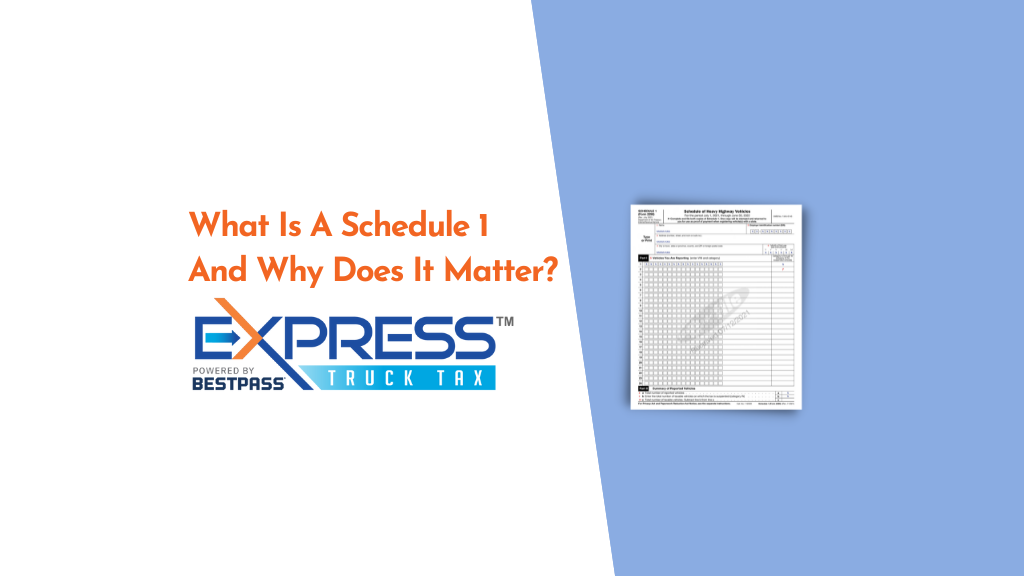

What is a Schedule 1 and Why is it Important for Truckers?

When it comes to heavy vehicle use taxes with the Internal Revenue Service (IRS), one crucial document that truck owners and operators must be familiar with is the stamped Schedule 1.

This document serves as proof of filing the Heavy Vehicle Use Tax (HVUT) and is an essential part of staying compliant with tax regulations. In this blog post, we will dive into the importance of the stamped Schedule 1 and its significance for trucking businesses.

What is a Stamped Schedule 1?

The stamped Schedule 1, also known as IRS Form 2290 Schedule 1, is a document issued by the IRS to confirm that the Heavy Vehicle Use Tax has been filed for a particular business and vehicle. It indicates that the vehicle’s owner has fulfilled their tax obligations for the tax period specified on the document.

The Schedule 1 is stamped by the IRS upon successfully processing Form 2290, which is filed annually by truck owners operating vehicles with a gross weight of 55,000 pounds or more. When you e-file your Form 2290, the stamp is an electronic stamp. Whether you have a red manual stamp or a gray electronic stamp, your IRP office must accept that document. 

Why is the Stamped Schedule 1 Important?

The stamped Schedule 1 holds significant importance for several reasons:

Proof of Filing: The stamped Schedule 1 proves that the HVUT has been filed (and paid) for the specified tax period. It acts as a receipt and confirmation that the vehicle owner is in compliance with tax regulations. Many authorities, including state DMVs and law enforcement agencies, may request a copy of the stamped Schedule 1 as evidence of tax payment.

Vehicle Registration and Renewal: The stamped Schedule 1 is required when registering or renewing the registration of a heavy vehicle. DMVs typically ask for this document to ensure that the vehicle’s owner has met their tax obligations. Without a valid stamped Schedule 1, the registration process may be delayed or denied.

Operating Authority: For commercial trucking businesses, obtaining operating authority from agencies like the Federal Motor Carrier Safety Administration (FMCSA) may require a valid stamped Schedule 1 as part of the application process. It demonstrates that the business complies with HVUT requirements and has paid the necessary taxes.

Proof of Compliance: In addition to serving as proof of filing, the stamped Schedule 1 demonstrates a truck owner’s commitment to compliance with tax regulations. It reflects their adherence to their tax obligations and helps build a reputation for reliability and professionalism within the trucking industry.

Obtaining the Stamped Schedule 1

To obtain a stamped Schedule 1, truck owners and fleet managers must first file Form 2290 with the IRS and pay the applicable Heavy Vehicle Use Tax. This can be done electronically through authorized IRS e-file provider like ExpresTruckTax, which offers a convenient and efficient way to file and receive the stamped Schedule 1 in a timely manner.

Electronic filing saves time, eliminates the need for paper forms, and expedites the processing of tax returns. You will receive your stamped Schedule 1 in minutes instead of weeks. 

In conclusion, the stamped Schedule 1 is a critical document for truck owners and operators. It serves as proof of filing for the Heavy Vehicle Use Tax and is vital to compliance with tax regulations. Truck owners should ensure that they file Form 2290 and obtain the stamped Schedule 1 promptly to avoid any delays in vehicle registration or operating authority. 

Please note that the information provided in this blog post is for general informational purposes only and should not be considered as legal, tax, or financial advice. For specific guidance related to your individual situation, it is recommended to consult with a professional tax advisor or the IRS directly.

FAQ Friday: How Can You Get A Copy Of Your Form 2290 Stamped Schedule 1?

What is a Stamped Schedule 1?

Vehicles weighing 55,000 pounds or more must have a Stamped Schedule 1 to get tags and the registration. In order to obtain a Stamped Schedule 1 you must first file Form 2290 for the Heavy Vehicle Use Tax. This form must be filed annually with the IRS. 

Receiving Your Stamped Schedule 1

If you want to receive your Stamped Schedule 1 as quickly as possible, e-file your Form 2290 with ExpressTruckTax. This entire process takes only a few minutes. Once all of your business, vehicle, and payment information is entered, transmit your form. Once your Form 2290 is accepted, you will receive your Stamp Schedule 1 via the email your ExpressTruckTax account was registered with, within minutes. You also have the option to receive your Stamped Schedule 1 via fax or mail at an additional fee. You also have the option to log in to your ExpressTruckTax account and download a copy of your Stamped Schedule 1. You can do this by going to your dashboard to the list of returns that you filed. Click “Download” under the “Schedule 1/Acceptance Letter” column for any return you need the Stamped Schedule 1 for. 

You are also able to paper file Form 2290 with the IRS, however, the entire process takes a long time. Once you file your form, you will not know if your form has been accepted for several weeks. If it is rejected you will have to file it again and wait another few weeks before you get a response. In order to get your Stamped Schedule 1 after paper filing Form 2290, you can either get it via fax or through the mail. 

File Form 2290 with ExpressTruckTax Today

Do you need to get your tags and vehicle registration for your vehicle weighing 55,000 pounds or more and need your Stamped Schedule 1 as soon as possible? If you e-file your Form 2290 with ExpressTruckTax today, you will receive your Stamped Schedule 1 within minutes of it being accepted. What are you waiting for? E-file your Form 2290 with ExpressTruckTax today to get your Stamped Schedule 1 as soon as possible.

How to Have Your 2290 Schedule 1 Sent Automatically to Your Carrier

If you’re a company driver, you’ll need to file your Form 2290 and get one copy of your stamped Schedule 1 for yourself and another copy as proof of payment for your carrier.

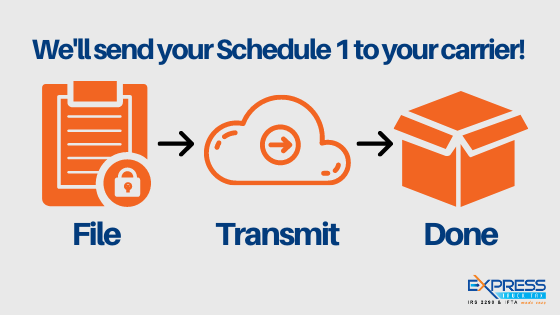
ExpressTruckTax simplifies that process by sending your Schedule 1 to your carrier for you.

Here’s what you need to know about 2290 carrier notifications from ExpressTruckTax.

When you finish e-filing your Form 2290 with ExpressTruckTax, it will be transmitted directly to the IRS for approval. In most cases, the IRS will accept the return within a few minutes and send back your stamped Schedule 1.

How to send your 2290 Schedule 1 to your carrier

There are two ways to get your HVUT proof of payment sent to your carrier.

1. Use your carrier’s unique ExpressTruckTax portal.

We partner with some of the largest carriers in the nation! Find out if your carrier has an existing portal with us using this list

If you find your carrier, simply file your 2290 through their portal. Your stamped Schedule 1 will automatically be sent to them!

2. Enter your carrier’s information after you file.

If you cannot find your carrier in our list our partners, don’t worry! Simply log in to ExpressTruckTax and file your Form 2290! Once your return has been transmitted to the IRS, go to “Add Carrier Details” under the Carrier Notification tab. 

Here you can provide the contact information for your carrier. As soon as your return is accepted by the IRS and your stamped Schedule 1 comes back to your ExpressTruckTax account, we will send it to your carrier immediately. 

Simplify your Form 2290 with ExpressTruckTax

Don’t waste time waiting for your Schedule 1 to get to you or your carrier in the mail. Finish the entire 2290 process in just a few minutes with ExpressTruckTax!

How To Get 2290 Schedule 1 (HVUT Proof Of Payment) Quickly

It’s time to file your Form 2290 for 2020! The IRS is now processing 2290 returns for 2020-21.

In order to remain compliant and avoid fines and penalties, you need to file your 2290 and get a stamped Form 2290 Schedule 1 (HVUT proof of payment) to keep in the cab of your truck.

If you get pulled over, you’ll need your HVUT proof payment to show that you have filed your 2290 taxes for 2020. As long as you pay your taxes before the August 31 due date, you can e-file today!

Here’s the quickest and easiest way to get your 2290 Schedule 1, today!

How to get your HVUT proof of payment in minutes!

The best way to get your 2290 Schedule 1 back today is to e-file your Form 2290.

Unlike using a paper form (which also takes longer to fill out), e-filing instantly transmits your return to the IRS for approval and provides you with the quick processing.

So, in the time it would take you just to fill out your 2290 on paper, you’ll have completed filing and gotten your HVUT proof of payment back.

There’s no need to wait days or weeks on the postal when you could have the burden of the Form 2290 off your back in just a few minutes.

E-file Now with ExpressTruckTax and Get 2290 Schedule 1 in Minutes

With ExpressTruckTax, e-filing Form 2290 is easier than ever!

We offer a simplified interview-style e-filing process, an instant audit that checks for common errors, free VIN corrections, US-based customer support, and quick 2290 Schedule 1!

Here we have listed the few top frequently asked questions about Form 2290 Schedule 1.

E-filing starts at just $9.90 for a single truck!

Get started today!

Last Chance! File Your IRS 2290 Today

Before you start making plans for Labor Day weekend, don’t forget that your Form 2290 for 2019 is due September 3rd, 2019.

While you may be tempted to wait until the last minute, remember that the IRS will be closed for maintenance 8/31-9/2. File this week.

Plus, if anything were to happen and your IRS is rejected, you’ll need the extra time to make corrections.

It’s best to just act like the usual August 31st deadline is still in effect.

Here’s how to file IRS Form 2290 before your holiday weekend.

The Rundown on Form 2290 for 2019

Form 2290 Due Date

When is 2290 due? Let’s reiterate: This year’s Form 2290 due date has been pushed back to September 3rd, 2019.

The usual August 31st date falls on a weekend, and the following business day is a holiday – Labor Day.

Therefore, Tuesday, September 3rd, is the deadline.

I’ve heard plenty of people assume they’re too late and might as well just file later or paper file and accept the penalty.

There’s literally no reason to do that. Filing IRS Form 2290 online before the Form 2290 due date is quick and painless. Plus, it’s affordable.

You’ll save money and time – no negative side effects.

IRS Form 2290 Filing Tips

If you want to make IRS 2290 filing the most efficient process possible, gather your information first.

You’ll need your EIN, VIN, business information, vehicle’s gross taxable weight, authorized signatory details, and payment information.

Then, file IRS 2290 online with an IRS-authorized e-file provider, such as ExpressTruckTax, the industry leader.

Once you’ve created a free account, you’ll follow the simple steps of the ExpressTruckTax interview-style process, dedicated to making taxes easy.

You can even complete these steps on your cell phone.

Our system is dedicated to fitting IRS Form 2290 for 2019 into your busy life on the go.

If at any point you have questions or get stuck, simply call our US-based, live customer support team located in Rock Hill, SC.

File 2290 Form 2019 on time. Trust me, you’ll be glad you did.

The Quickest Way to File

The IRS recommends online filing for quickness and ease of approval for Form 2290 for 2019.

Not only will filing online help the IRS accept your 2290 Form 2019 within a reasonable amount of time, but it will also ensure that you receive a copy of your Schedule 1 Form 2290 quickly.

When you file online with ExpressTruckTax, you’ll receive your Schedule 1 Form 2290 just minutes after filing your 2290 Form 2019 with the IRS.

Plus, you’ll have access to free VIN corrections and an instant error check, so you won’t have to worry about having to file IRS 2290 more than once.

Take a moment and get it done with ExpressTruckTax!

So, What’s the Deal with the IRS 2290 Deadline?

If you’re reading this article, you probably know that you need to file your IRS 2290 soon.

But did you know that the 2290 filing deadline is September 3rd, 2019, not the usual August 31st?

Maybe you’re wondering why the 2290 deadline is different.

Or perhaps you have some confusion surrounding filing IRS Form 2290 and paying your actual IRS 2290 payment.

Better yet, you might be thinking about how much of a hassle this is, and wondering why it’s necessary in the first place.

Well, you’re about to find out! I’m here to answer all of your IRS 2290 questions.

Form 2290 Due Date

Why September 3rd?

Normally, the Form 2290 deadline is August 31st.

This year, that date falls on a Saturday. The next business day would be Monday, September 2nd, but that’s Labor Day.

Therefore, this year, the Form 2290 due date is September 3rd, 2019.

You might be thinking about how lucky you are to get a couple extra days this year but think again.

As tempting as it may be to wait until the last minute, how likely are you to think about filing IRS 2290 and paying your 2290 highway use tax after a weekend and holiday…?

Trust me. File today or, at the very latest, file August 30th. That way you’ll ensure that the 2290 deadline is met.

Plus, if there are any issues or your IRS Form 2290 is rejected and you need to make corrections, you’ll have time to do so before the Form 2290 due date.

I’m not asking much. If you file with an IRS-authorized e-file provider like ExpressTruckTax the whole process takes as little as 10 minutes.

Seriously, just get it over with.

What About the IRS 2290 Payment?

So, you might’ve heard that if you can’t afford to pay your IRS 2290 payment right now, you should go ahead and file IRS Form 2290 anyway.

This is true.

Failing to file IRS Form 2290 by the 2290 filing deadline will result in a penalty of 4.5% of the 2290 highway use tax due. This will increase monthly for up to 5 months.

However, the penalty for failing to pay your IRS 2290 payment is only 0.5% of your total tax amount, plus additional interest of 0.54% per month.

Even if you can’t afford to pay your IRS 2290 payment right now, you should still file.

If you file but do not pay your full 2290 highway use tax amount, you’ll face a much lower penalty (0.5% compared to 4.5% of the total tax due).

Maybe you can pay by September 3rd, but not by tomorrow.

File today anyway.

You don’t want to get stuck with a rejected return or worse, without a 2290 Schedule 1.
You may face unexpected penalties.
You never know what could happen. Take a moment to file now.

When Will I Get My 2290 Schedule 1?

Your 2290 Schedule 1 is a huge part of why it’s so critical for you to file on time.

An updated 2290 Schedule 1 is necessary for operation, including anything from renewing your tags to traveling internationally or renewing your IFTA license.

If you file IRS 2290 online with ExpressTruckTax, you’ll get a copy of your 2290 Schedule 1 just minutes after IRS Form 2290 filing. It doesn’t get much easier than that.

Your HVUT Form 2290 is Due Next Thursday

Heavy Vehicle Use Tax Form 2290

What’s on your mind? The fact that it’s pretty hot and humid at this point during the summer, the fact that Labor Day is almost here to enjoy, or the fact that your Heavy Vehicle Use Tax (HVUT) Form 2290 is due by next Thursday, on August 31st?

If your mind isn’t on the deadline, then it should be, for at least 5 minutes, because that’s all it takes to quickly and conveniently file your Form 2290 with ExpressTruckTax in order to receive a copy of your stamped Schedule 1 via email within about 15 minutes, depending on IRS volume. Also, so you can become a HVUT expert we have put together a list of HVUT facts.

All About The HVUT

So what exactly is the HVUT? It is the tax assessed on the use of public highways by heavy vehicles with gross weights of 55,000 pounds or more. The taxes collected are used to repair, maintain, and build public highways.

You must file HVUT Form 2290 for every taxable highway motor vehicle that is required to be registered in your name under state, District of Columbia, Canadian, or Mexican law at the time of its first use period.

A taxable highway motor vehicle is one with a taxable gross weight of 55,000 pounds or more and includes any self-propelled vehicle designed to carry loads over public highways, regardless if it’s designed to perform other functions. A taxable vehicle consists of a chassis or a chassis and a body but does not include the load.

E-filing App For Form 2290 HVUT
The current HVUT tax period began on July 1, 2017, and will end on June 30, 2018. The HVUT is based on your first use month and is due by the last day of the month following the first use month. For example, if you first use your truck in October then your Form 2290 will be due by November 30th. Because a majority of truckers first use their trucks in July, the last day of the following month, which is August 31st is a huge deadline day.

As a result of filing your Form 2290, you will get a copy of your stamped Schedule 1 which serves as your proof of payment. It actually has a digital watermark stamp that includes the time that the IRS approved and accepted your Form 2290. Your stamped Schedule 1 is very important because you need it to register new vehicles and to renew your vehicle tags. Without it, you will be operating illegally.

Luckily filing Form 2290 is extremely easy and some of your information can be found on previous stamped Schedule 1s. All you need to file is your business name, address, and EIN (Employer Identification Number). For your vehicles, you need the VIN (Vehicle Identification Number) and taxable gross weight.

How to E-File Form 2290?

You can actually file Form 2290 in 5 minutes or less with ExpressTruckTax. Simply head to ExpressTruckTax.com or download the ExpressTruckTax app to your smartphone or tablet and follow the step-by-step e-filing guide to instantly complete your Form 2290. Then you will receive a copy of your stamped Schedule 1 via email within about 15 minutes.

For an even easier way to file call ExpressTruckTax Plus at 803.386.0320 to have a US-based representative file for you. All you have to do is answer a few questions during a short phone call, then your filing process will be complete and you will receive your stamped Schedule 1 via email.

Contact ExpressTruckTax

Our dedicated, US-based support team is standing by to help. If you need any assistance give us a call Monday – Friday from 8 AM to 7 PM EST at 704.234.6005, connect with us via live chat, or take advantage of our 24/7 email support at support@expresstrucktax.com.

Forget to File Form 2290? You’re Going to Face Penalties!

The clock is seriously ticking! Every time a moment passes then we are getting even closer to the

Heavy Vehicle Use Tax (HVUT) deadline on August 31st. You still have about two weeks to file, but don’t wait. You should still file as soon as you can.

If you run into errors and your form gets rejected then you will be responsible for correcting your form and retransmitting it by the deadline. If your Form 2290 or HVUT payment is late you will have a few penalties to face.

HVUT Penalties

You may not receive a penalty for filing your return or paying the amount of HVUT tax you owe by the deadline if you are able to show reasonable cause for not filing or paying on time. If your file after the deadline be sure to attach an explanation to your return to show reasonable cause. The reasonable cause may then be accepted or rejected by the IRS.

Now the penalty for failing to file your HVUT IRS Form 2290 by the August 31 deadline is equal to 4.5% of the total tax due, and this penalty will accrue on a monthly basis for up to five months. The penalty for not making a HVUT payment is a monthly fee of .5% of the total tax due. You will also face an additional interest charge of .54% per month. This penalty can make the amount you owe increase pretty quickly.

Note: There are also penalties for filing fraudulent or false returns.

In addition to these federal penalties, your state may suspend your vehicle registration until you can provide proof of your HVUT payment. Your stamped Schedule 1 serves as your proof of payment, and you receive it by filing Form 2290. You need a stamped Schedule 1 to renew your tags and register new vehicles. Without it, you will be operating illegally.

How to File HVUT Form 2290?

Now that you know you really need to file your HVUT Form 2290 by the deadline, don’t panic. You can quickly and conveniently file right now by heading to ExpressTruckTax.com or by using the ExpressTruckTax App on your smartphone or tablet. All you have to do is follow the e-filing guide.

Either on the site or app, you will create your free ExpressTruckTax account with your email address. Then you will enter your business information like the name, address, and EIN (Employer Identification Number). Sole proprietors may use their personal information.

Then you will enter your tax year and first used month before entering your vehicle information, including the VIN (vehicle Identification Number) and the taxable gross weight. This is also where you will select if your vehicle was used for any special purposes such as logging, or agricultural use. Remember to include any suspended vehicles.

penalties for filing HUVT Form 2290 late

Next, we will accurately calculate how much HVUT you owe for you. Then you can directly pay that amount to the IRS through direct debit or electronic funds withdrawal, EFTPS, or check or money order.

After that, we will perform a basic audit check on your form to catch any basic errors. Also, we will present you with a summary of your information so you can make sure all of your information has been entered correctly. Once any corrections have been made you can sign your form with a 5-digit number of your choice, pay for it, and transmit it directly to the IRS.

Last but not least, you will receive a copy of your stamped Schedule 1 via email, within about 15 minutes of transmitting it. You can also elect to have it faxed, texted, or mailed anywhere it needs to go.

For an even easier way to file call ExpressTruckTax Plus at 803.386.0320 to have one of their HVUT 2290 experts file for you, over the phone. With one quick call you will have your form filed and you will receive a copy of your stamped Schedule 1 via email.

We’re Here To Help

If you have any questions regarding your truck taxes please don’t hesitate to contact the outstanding, US-based ExpressTruckTax support team. We’re available over the phone Monday – Friday from 8 AM to 7 PM EST at 704.234.6005. You can also connect with us via live chat and we offer 24/7 email support at support@expresstrucktax.com.

Common Reasons for Form 2290 Rejections

As the HVUT deadline races towards us, it’s important to remember to give yourself enough time to file our Heavy Vehicle Use Tax 2290 Forms to make it by the August 31st deadline. If you wait until the last minute to file and your form is rejected then it’s up to you to correct it and retransmit it to the IRS in time, otherwise, you will face late filing penalties.

So why wait? Go ahead and use ExpressTruckTax to quickly and conveniently knock out your Form 2290 today and use the following tips about why 2290 forms are commonly rejected to get yours accepted the first time.

Why 2290 Forms Are Commonly Rejected

EIN Problems

You need an EIN or Employer Identification Number to complete your Form 2290. There’s no way around it. Once you place your SSN in place of your EIN on your form then it will instantly be rejected.

If you need an EIN go apply for one with the IRS now because it takes about two weeks for them to become updated in the IRS’s system and your form can get rejected during that time. Even though you’ll get your EIN instantly when you apply for one, you have to wait for it to become active before you can file.

You also need to make sure that your business information matches the information that you have on file for your EIN with the IRS. If they don’t match then your form could get rejected. You can verify your information with the IRS by calling 1-888-829-4933.

Your Form is a Duplicate

Each VIN (Vehicle Identification Number) can only be filed for once during the HVUT tax period. Duplicates will be rejected, so make sure that you’re filing for the current tax period which runs from July 1st, 2017 to June 30th, 2018. If you accidentally filed for the previous tax period then that could be why your form is considered a duplicate.

You also need to make sure that you enter your VIN correctly. If it’s one character off then your form could get rejected. If your form is rejected for this reason don’t panic, you can quickly and easily file free VIN corrections with ExpressTruckTax.

RTN Errors

You can pay the amount of HVUT you owe to the IRS through direct debit or electronic funds withdrawal, and that process involves providing your bank account number and RTN (Routing Transfer Number).

If you enter this information with as little as one character off the IRS will not be able to debit the funds and your form will be rejected. This is also the case if you do not have enough funds in your account to cover the full amount.

Enter your information, which can be found on one of your checks correctly. If your form is rejected for the incorrect RTN or insufficient funds simply edit your form and retransmit it or choose a different payment method.

When Filing Your Form 2290… 

ExpressTruckTax is your best e-filing option. You can follow the step-by-step guide to instantly complete your form and receive a copy of your stamped Schedule 1 within about 15 minutes of filing. Plus, ExpressTruckTax makes it incredibly easy to file amendments, edit your form, make free VIN corrections, and more.

Also, with the ExpressTruckTax app, you can file from any location at any time right from your smartphone or tablet. Meaning you can file even if you’re out on a trip!

Another great way to instantly file is by calling ExpressTruckTax Plus at 803.386.0320 to have a representative file for you, over the phone. By making one call you’ll have your 2290 filed and you will receive a copy of your stamped Schedule 1 via email.

We’re Here To Help

If you need any assistance contact our dedicated, US-based support team Monday- Friday from 8 AM to 7 PM EST at 704.234.6005. We’re also available via live chat and offer 24/7 email support at support@expresstrucktax.com